
FastForward #73: AI search is breaking the web's business model

Hi everyone. This week we return to a normal format with the news of the week. Let me know if you like the news briefs or prefer the streamlined version I've been running the past couple of weeks. Send your comments to feedback@fastforward.blog. If you like my newsletter, please share this week’s edition with a friend, and encourage them to subscribe. It really helps.💌 Sign up here.
ForwardThinking 🤔
AI search is breaking the web's business model
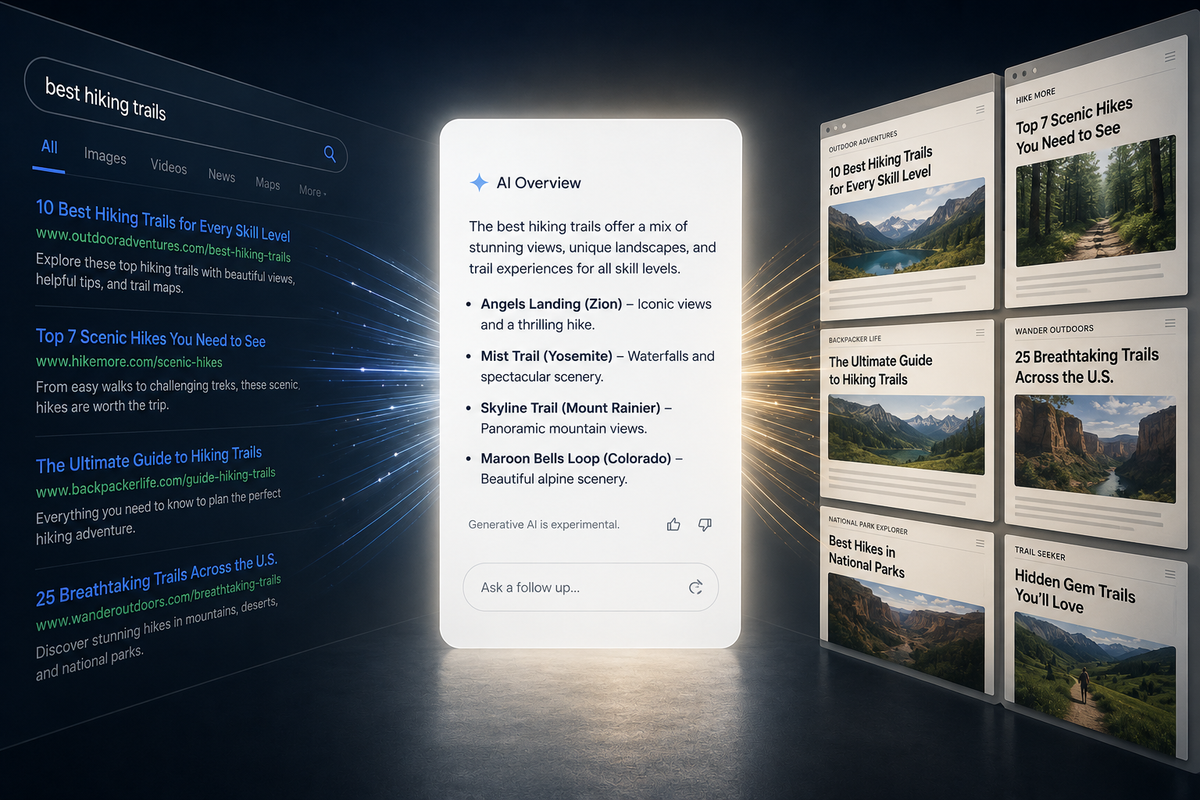
For 25 years, Google was a reliable waystation on the way to a website. You entered a few keywords, clicked a link or two and generally found what you wanted. AI search is altering that relationship. And it's not just changing how we search, it's eroding the economic model that has supported much of the web for more than two decades.
This shift has had a profound impact on website traffic. Search referrals have seen a precipitous drop since Google added the AI summary in May 2024. A July 2025 study by Pew in which 900 people agreed to have their search tracked found that people were half as likely to click on a link when the AI summary appeared (8% with summary, 15% without).
A February 2026 report by Ahrefs, a company that sells SEO tools, looked purely at clicks and found that searches with AI summaries generated 58% fewer clicks. So the trend is real. People are clearly clicking through to websites less and less.
While it's clearly a negative outcome for sites which have benefited from search traffic in the past, from a user perspective, the idea of asking a question, getting an answer and continuing the conversation has a lot of merit. Of course, we have to be concerned about the quality and accuracy of those answers.
The Pew study found that the most frequently cited sources for AI summaries were Wikipedia, YouTube and Reddit. While Wikipedia's reputation is mostly good when it comes to accuracy, there is objectively a ton of unreliable information on the other two sites, and Pew found that users who encountered an AI summary, clicked through to check the source just 1% of the time.
Looking for answers
All of this means that Google is transforming from a search engine to an answer engine. You could argue that this is just a natural evolution as AI becomes more prominent. But Google isn't the only service changing the way we search.
People are also turning to Claude, ChatGPT, Perplexity or other AI models to ask the same types of questions they might ask Google. So search is not only shifting in style, it's beginning to fragment in ways we haven't seen in many years.
And while that makes sense from a technology perspective, it breaks a key economic bargain that helped build the web and has existed for most of Google's history. It was a cycle where websites created content, Google drove traffic to the site via links and the sites sold ads to pay for the content. That virtuous cycle made a lot of businesses a lot of money because it was infinitely repeatable. Suddenly, it's being pulled away and that's having a real impact with journalism offering one of the best examples.

As traffic declines along with ad revenue, sites have been cutting back, been sold to private equity firms or shut down. Journalists have been being laid off and newsrooms decimated. And that's just one highly visible example. It’s having a rippling effect across all types of sites.
With that compact collapsing, it raises the question, who pays for the content on the web now. Blogs like this one were created as content engines. If the traffic is gone and the ad money is drying up, what happens to the content?
It’s a good question. Even if you believe AI is a better way to get answers, and that’s debatable, it still depends on the same steady supply of articles, data, information and documentation that used to come from websites. The problem is that no one has yet figured out a new model to create content at the scale that the old web model provided.
~Ron
What's new on the blog 📰
After IBM stock takes a beating, what comes next?
In my latest collab with Alex Wilhelm from the Cautious Optimism blog, my former TechCrunch colleague and I dig into IBM's disastrous second quarter earnings report, one so bad that CEO Arvind Krishna sent out a letter to shareholders before the report came out to soften the blow and let them know what was coming.
After that letter was delivered, investors reacted badly with a record one-day stock price drop of 25%. The questions is, was this an over-reaction to one bad quarter or a more dangerous signal.
The startup unit inside Zscaler working to secure AI
Why would a large company build a startup unit within the broader organization? When I was at Zscaler Zenith Live 2026 in Las Vegas last month, I sat down to do a video interview with Swamy Kocherlakota, who runs such a unit inside Zscaler, to learn more about his role.
He said it was about generating speed and agility inside a larger organization that tends to move more slowly:
"AI is moving very fast, and customers' needs are moving fast. Every day there is a press release or an update. The question really is, how do you build products that allow our customers to protect AI and take advantage of AI."
Note that this interview series is part of a paid engagement with Zscaler. My editorial standards and guidelines apply regardless. See my full disclosure statement at the bottom of the piece.
Pega founder Alan Trefler thinks big AI is selling fear
Pega CEO Alan Trefler founded his company in the 1980s, and he's been around long enough to call out big AI when he sees fear mongering and manipulation.
"They're both trying to scare them into thinking it's all powerful, and also scare them into thinking that if they don't use it, they're going to fall behind."
I spoke to Trefler about how his company's workflow software has been designed to use AI strategically, rather than as the center of the system, an approach he believes will help them control costs and give customers more predictable bills

Investor Jai Das on AI hype and the changing face of enterprise investing
I caught up with Sapphire Ventures co-founder Jai Das in April at HumanX. We talked about AI hype and the changing investment environment.
As the AI labs try to muscle into areas traditionally covered by Enterprise SaaS companies, he says there are still areas where enterprise investors can succeed.
"I'm in a little bit a better position than my colleagues who look more at apps because I do more on the infrastructure and software. So those layers, I think, are not going to get disintermediated by the models as much.”
Why Abby Kearns thinks AI has changed the rules for the open source software supply chain
I first met Abby Kearns when she was running Cloud Foundry a decade ago. Today, she is CEO at ActiveState, a company that is trying to create a way to keep software libraries safe at a time when the open source software supply chain has been under increasing attack.
She said recent moves by the Linux Foundation and IBM and Red Hat show the industry recognizes there is a serious problem.
"When institutions of that scale stand up coordinated programs around open source supply chain protection, the consensus has changed. This is no longer treated as a niche security topic. It is a crisis and recognition is finally catching up to the pace at which the exposure has been building."
News of the Week 📣
Assaf Keren is moving to Meta to be its next CISO
Former Qualtrics chief security officer Assaf Keren announced on LinkedIn earlier this month that he's joining Meta as its next CISO. He will be replacing outgoing CISO Guy Rosen, who is expected to depart later this year after a period of transition.
Keren spent almost a decade at PayPal in various security roles, finishing his last couple of years as CISO. He joined Qualtrics in March 2024. When I spoke to him for a FastForward profile in June 2025, Keren told me that regardless of the company, security hygiene basics always matter.
That approach should serve him well as he moves to a much larger organization. As I wrote in my profile, "For him, the fundamentals include knowing your assets and software versions, maintaining disciplined code deployment processes, ensuring visibility into your environment and managing vulnerabilities quickly, among other things."
But Meta is his biggest challenge yet and he recognizes the enormity of the responsibility. "Few organizations carry the responsibility Meta does. Billions of people trust its platforms for how they connect, communicate, and, increasingly, use AI in their daily lives," he wrote on LinkedIn.
"Protecting that trust, the security of the systems, the integrity of the platform, and the safety of the people on it is one of the most consequential jobs in our industry."
As he moves from an enterprise software company like Qualtrics to a multifaceted platform with big AI ambitions, he's taking on a huge challenge.
Amazon shutters AGI lab among broader cuts

In a surprise move earlier this month, Amazon announced it was closing its AGI lab in San Francisco amid layoffs and cost cutting at the retail giant, according to reports from multiple outlets including Reuters and GeekWire.
Amazon told these outlets that it will continue to work on advanced models, but it wants to concentrate on areas that help customers today.
Simply put, AGI or artificial general intelligence involves models with human-like intelligence. There is some debate about the definition, and when or even if it will happen, but the shuttering of a lab devoted to it by one of the largest hyperscalers in the world is a signal that it's not close and Amazon has other priorities.
The company opened the lab 18 months ago to much fanfare by hiring a bunch of talent from Adept, a San Francisco startup that was building a model to run autonomous agents. Much of the leadership team joined the company, but GeekWire reports that many of those folks have since left and the company decided to lay off or reassign the remainder.
David Linthicum, an analyst who covers AI and the cloud, wrote on LinkedIn that it shows that AGI isn't quite as far along as we have been led to believe. "This was the lab that was supposed to build AI as smart as a human. You know, the lab where they hired a bunch of people from Adept, spent gobs of money, and made big promises. Gone. Just like that."
Cloud infrastructure market surges in Q2 to highest growth rate in 8 years

The Big 3 – Amazon, Microsoft and Google – all had remarkable growth in the second quarter with the market as a whole growing 43% to reach $143 billion, per Synergy Research.
AWS revenue grew 37% YoY, while Azure revenue was up 43% and Google Cloud up an astounding 82%.
Synergy reports that Amazon remains the clear market leader after all these years with 28%, Microsoft is second at 20% and Google third with 15%. Oracle remains mired in single digits at 4%.
All of this was of course fueled by AI. "AI technology has lit a fire under the cloud market and is now driving unprecedented growth. GenAI-specific cloud services are growing at 165% year over year, but equally importantly, AI technology is enabling enhanced functionality and increased growth across a much broader range of cloud services," Synergy chief analyst John Dinsdale wrote in his quarterly report.
I've said it before, but it bears repeating, this kind of growth from a market this mature is remarkable, but it comes at a cost. Each of the companies is also reporting surging capex spending to try to keep up with this demand, so in some ways the growth in revenue is being offset by the tremendous amount of money each company has to spend to feed the data center hunger that is fueling the growth.
I'll have more on this next week in a deeper look at the cloud numbers.
What I'm reading 📚

Russia charges Telegram founder Durov with aiding terrorism, he gives Moscow the finger
~By Reuters
Inside one London founder house rewriting the founder-house rules
~By Dominic-Madori Davis, TechCrunch
Young adults are letting AI do their talking for them—even in person
~By Natalie Kaufman, Wall Street Journal
What I'm watching 📺
Jyoti Bansal, Harness CEO Interview
~Fortt Knox, CNBC
Look who's talking 👄
"Enterprises aren’t going all in on one provider. I wouldn’t call this a temporary glitch. I’d call this part of the cracks in the AI market being shown."
~Analyst Maribel Lopez from Lopez Research on how the changing AI market is impacting IBM, as told to FastForward.