FastForward #80: The end of the user interface


Hi everyone. I’d like to thank Akamai once again for supporting FastForward for the month of September. If you're interested in advertising, please drop me a line at ads@fastforward.blog. If you like what you see, please share this week’s edition with a friend, and encourage them to subscribe. It really helps.💌 Sign up here.

ForwardThinking 🤔
The end of the user interface
While the AI labs were sending out scary pronouncements and talking about slowing the pace of frontier development, Salesforce was holding its annual customer carnival in San Francisco this week, giving its customers a very different message.
Benioff and friends weren’t there to discuss how AI could potentially wipe out humanity. They were more interested in how AI could wipe out the user interface as we’ve known it.
Of course, there was pageantry aplenty at the Dreamforce keynote on Tuesday where the news kept coming for two solid hours and where guests included the rather bland Anthropic CEO Dario Amodei and the surprisingly entertaining Jensen Huang, perhaps the only person on the planet who could upstage Marc Benioff.
But they weren’t there to merely celebrate the tech glitterati, they were there to sell the latest shiny new approach to the Salesforce platform. Even though Salesforce has been around for 27 years, the company recognizes that the times they are a-changin’. The CRM giant clearly understands that data is the lifeblood of AI models, and they have a lot of valuable business data. The way you enter and access it might not matter as much anymore.
The end of the world as we know it
In fact, Salesforce president of applications and marketing Patrick Stokes went so far as to say that the UI was never the interesting part of Salesforce, a huge admission for an enterprise software exec.
“The value of Salesforce has never been in the UI. It's been in the platform that stores the way our customers encode their business, and I think that might even be true for a lot of software, a lot of enterprise software,” Stokes said at the pre-keynote press event.
But he was just following the lead of Salesforce co-founder and tech guru Parker Harris, who designed the Lightning interface, which has been the center of Salesforce software lo these many years. At an event in March, Harris said, “I built the Lightning UI. I worked really hard on it. Why should you ever log into Salesforce again? Maybe you never will.”
A bold shift
All of this is an audacious viewpoint for a company like Salesforce, and it could speak to a future where the interface as we’ve known it melts away. It ties directly into the Headless 360 products announced earlier this year and the partnership with Anthropic around the recently announced Claudeforce product, each of which showed that Salesforce is walking the walk, not just talking the talk when it comes to eventually deprecating the interface. Headless gives customers a way to help agents connect to Salesforce data on the back end, while products like Claudeforce give them one way to replace the front end.
As Stokes said, maybe we won’t even miss the user interface because it actually is complicated and has gotten in the way of the user experience. “What's so exciting about this is it kind of disaggregates the UI and brings AI in to kind of replace it. And I think that's very exciting,” he said.

He believes this idea is going to impact all enterprise software, and if the vision plays out as described and we have various AI labs offering a front end to interact with the valuable data, and we have these agents entering data alongside humans, the interface becomes less important over time as the emphasis shifts to all the juicy data, business logic and context that's produced by the act of using tools like Salesforce, SAP, Workday or ServiceNow.
For now, in reality the interface may not be dead, but it's not exactly resting comfortably either because Salesforce gets that how we interact with software could be changing in a fundamental way, and the companies selling that software have to change with it. Salesforce put everyone on notice this week that it's ready, willing and able to do that.
~Ron
What's new on the blog 📰
AI is making scammers smarter and helping Visa fight back
I spoke to Visa chief risk and client services officer, Paul Fabara about the challenges his company faces trying to root out fraud from the massive payments network.
One of the interesting things about AI tools is that both sides have access to the same models, but Fabara says Visa has a huge data advantage over bad actors:
"One of the things that crooks don't have access to is the same level of data that we do. And so that makes a tremendous difference when it comes to looking for that fraudulent transaction," he said.
Harness's Jyoti Bansal says CI/CD needs to be reimagined for AI coding
I had the pleasure of speaking with Harness founder and CEO Jyoti Bansal recently on the FastForward on PPN podcast.
He talked about how AI has changed coding and in the process may require a new way of thinking about the CI/CD pipeline, a concept that was built for human development speed.
"The number one thing is that the velocity is much higher now than it was a decade ago, for sure. Our team did an estimate, and we are shipping one big feature every 11 hours right now. I could not have imagined that a decade ago," Bansal said.
The entire podcast is embedded in the article. Well worth a look.
Nvidia-Hugging Face deal could raise questions about AI power consolidation
It's not exactly a secret that Nvidia is the richest company in the world, and if the Hugging Face deal passes regulatory muster, it will only add to its growing clout in the AI market. I suggest that perhaps regulators should take a closer look at this one.
Note that I pulled this article from the News of the week section in FastForward #78 and published it with light editing.

How Kyndryl’s separation from IBM prepared it for the AI era
I recently interviewed Kyndryl CIO Kim Basile about what she learned as the company separated from IBM a few years ago. And the really interesting thing was that it forced them to modernize their systems and get their data house in order, and without even knowing it at the time, prepare them for the AI age. It's a pretty fascinating story.
As she told me, the separation ended up preparing Kyndryl for what came next:
"It gave us a foundation and many companies are still trying to build that foundation."
How a 150-year-old insurance company is moving into the AI era
I interviewed MetLife CIO Nick Nadgauda to learn how a 150-year-old insurance company is transforming its tech stack for the AI age.
Using COBOL programs as an example, he says he looks at what to transform more from a maintainability perspective than a strict modernization one.
"I don’t necessarily have a problem with COBOL. The real problem in my mind is when you’ve got systems that you can’t support, where you can’t find programmers, you can’t find talent or they’re hard to modify."
News of the Week 📣
Salesforce and Nvidia make the case for specialized enterprise AI
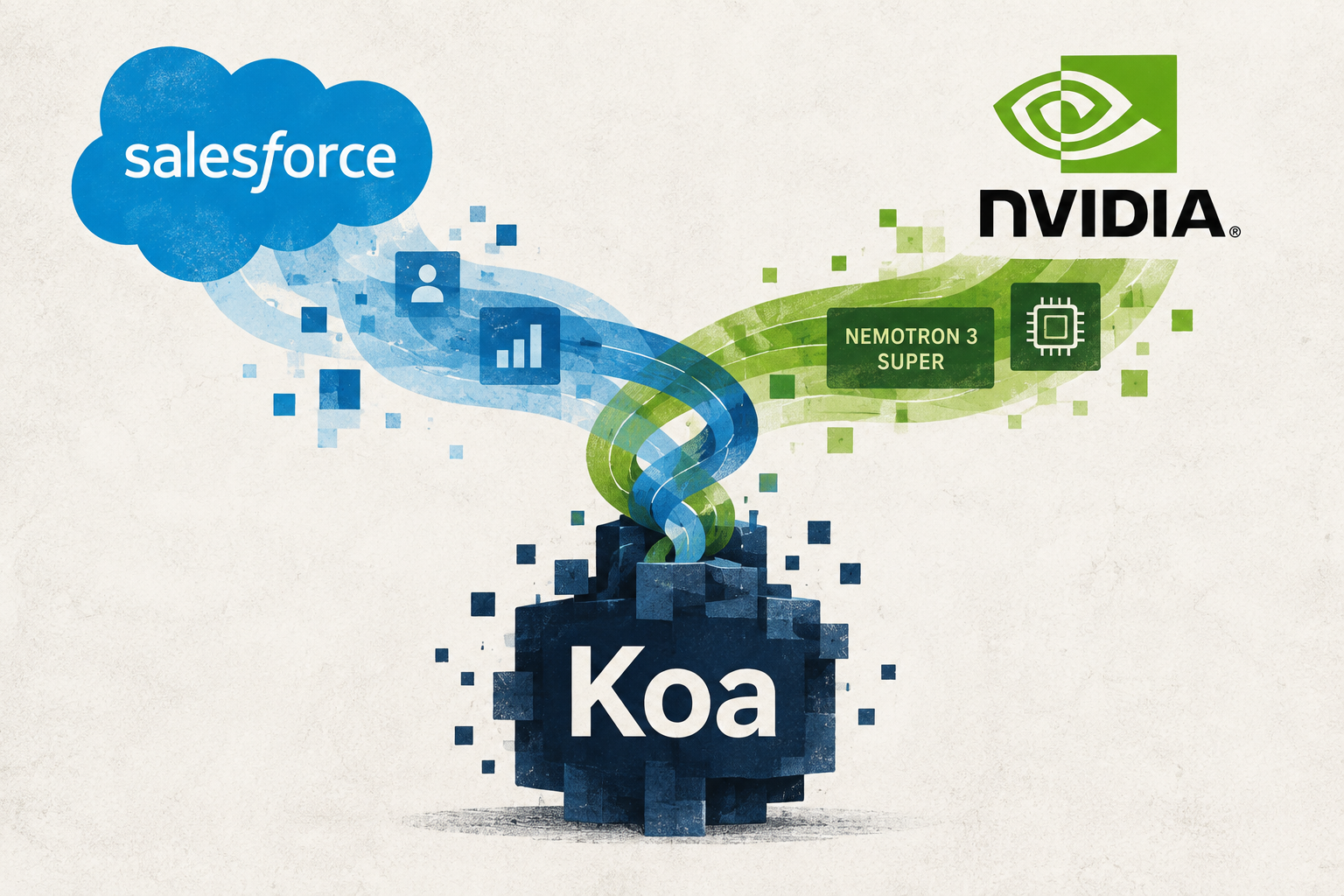
Salesforce announced a new specialized model this week called Koa. It's built on top of an Nvidia Nemotron 3 Super open weight model and was trained on a synthetic data set, rather than actual customer data.
The company describes Koa as the first purpose-built model designed for Agentforce, the company's agent-building platform. As Rohan Kumar, Salesforce's president and chief platform and engineering officer, who joined the company in June after nearly 28 years at Microsoft, said, the new model is designed to help deal with typical kinds of Salesforce workflows.
He uses a sales agent as an example. "We believe Koa is going to be a game changer. When you look at complex agents that do multi-step tasks such as a sales agent that's trying to figure out the next best step in closing a pretty phenomenal sales deal. Koa is going to help with that," Kumar said.
From an enterprise perspective, companies don't want their data used to train a model like this, even if it produced better results because for companies, privacy trumps accuracy. That's why Salesforce generated a synthetic data set instead of using actual company data.
As Salesforce described it, the synthetic data was generated from workflow scenarios across more than 14 industries. Salesforce used its familiarity with those workflows to create the data set. Assuming Salesforce did a good job generating these workflows, it could be a reasonable replacement for actual customer data.
Nvidia CEO Jensen Huang, appearing as a guest at the keynote, said that specialized models like this are part of the future of enterprise AI. “We see a future where the world uses closed models, but every company would also be able to build their own private models, their own customized models,” Huang said during the keynote.
Salesforce expects to make Koa generally available sometime between December 2026 and February 2027.
Anthropic combines chat and Cowork to alleviate tool confusion

Anthropic announced this week that it was combining chat and Cowork into a single product to reduce confusion among users. It seems people didn't know which one to use when, so Anthropic simply combined the two into a single product.
"We stopped making you choose. Claude can now figure out what a task needs, so what Cowork and Design can do is available from any conversation, with the context, skills and connectors you already have," the company wrote in a blog post announcing the change. Heck it's AI, it should be able to understand what you're trying to do.
On X, my former TechCrunch boss Matthew Panzarino, liked the change. "Absolutely the right call. The vast majority of users I have discussed Claude with had no idea what co-work was or why to use it. The gulf between the capability of a properly set up co-work instance and a chat is ridiculously vast," he wrote.
He's right. I could never tell the difference and just did all my work in Chat, regardless whether the task was asking a straight question or asking it to create an invoice for me. It seems I was ahead of the game and now that is how it will be done.
The new capability is rolling out on Pro and Max plans over the next several weeks, according to the company.
HubSpot wants AI to solve CRM’s data entry problem once and for all
When it comes to CRM, the database is only as good as the data in it, and sales people hate entering data. So what if AI did it for you?
That's the idea behind HubSpot's new self-updating Smart CRM, announced this week at the Hubspot Unbound customer conference in Boston. You may recall it used to be called Inbound as a nod to its inbound marketing roots, but given the company is focused on more than that now, it decided to change the name of the conference.
As for Smart CRM, the idea is to look across meetings, emails, calls and notes and pull information into the CRM database automatically without the sales person or a sales assistant having to do it. Sales managers no longer have to chase after staff for information because, at least in theory, it's being handled automatically in the background.
Unlike earlier CRM automation, which was largely about capturing and logging activity, the new Smart CRM is designed to use AI to understand those interactions and pull relevant information from them.
"Nothing works right if your CRM is out of date, so we fundamentally reimagined it for the AI era," the company wrote about the new capability.
The real test will be just how accurate the AI is when it comes to entering data and how much sales teams can trust the information it's pulling. If it works as described, it will solve a major pain point, but if it makes a lot of mistakes, humans will be left to clean up after it, and not much efficiency will be gained.
What I'm reading 📚

Hackers Stole Flock’s Camera Software, Revealing How the Company Tracks Cars and People
~By Joseph Cox & Dhruv Mehrotra, 404 Media
Automattic's interim CEO and legal chief signed reciprocal severance deals during Mullenweg's brief ouster
~By Sarah Perez, TechCrunch
AI Pioneer Andrew Ng Calls Extinction Fears ‘Science Fiction’
~By Micah Barkley, Bloomberg
What I'm watching 📺
The Future of AI-driven Software Delivery | Jyoti Bansal
~FastForward on PPN, Ron Miller
Look who's talking 👄
"AIs are not conscious. They do not feel, experience, or suffer. They do not have innate preferences or underlying motivations. They are sequence completion engines, internally hollow, designed to follow instructions, and accomplish goals set by humans."
~Mustafa Suleyman, 'A warning about ‘model welfare’ on Mustafa Suleyman blog