
After IBM stock takes a beating, what comes next?

The following post is a collaboration between Alex Wilhelm from the Cautious Optimism blog and FastForward. I set the stage regarding IBM’s messy quarter, digging into what analysts think about the company’s future prospects. Next, Alex dives into the financials to try to answer the question of what really lies ahead for Big Blue. Let's dig in. — Ron
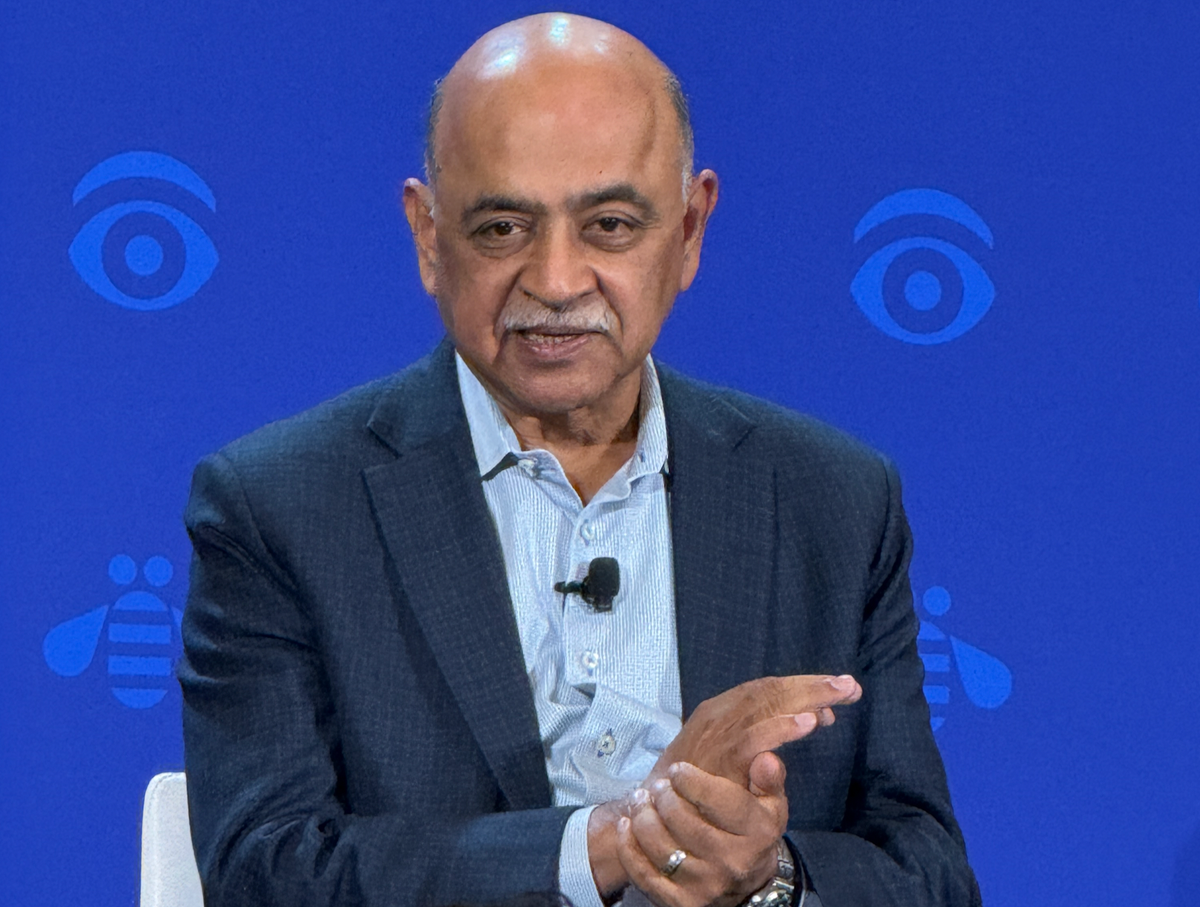
IBM had a bad quarter. How bad was it, Johnny? It was so bad…it was sooo bad…the CEO sent out a letter to shareholders before officially reporting earnings. Chief executive Arvind Krishna was measured but realistic in his written assessment, placing the blame for a soft quarter mostly on a shift from software to hardware sales and some sales delays late in the quarter.
The preliminary revenue numbers in the letter (later confirmed by the full report) were more than a little grim:
- Revenue of $17.2 billion, up 1 percent ($17.58 billion expected)
- Software revenue up 5 percent
- Consulting revenue flat, up 1 percent at constant currency
- Infrastructure revenue down 7 percent
Wall Street reacted swiftly and brutally, handing Big Blue a record one-day loss of 25%. The company has lost more than a fifth of its value thus far in 2026.
The promise of the Think Conference fades fast
IBM laid out a vision at its Think Conference in Boston this May, positioning the company to help customers overcome all of the obstacles to AI success. As Krishna said in his conference keynote, customers "don't fail because of the AI [technology]. They often fail because of what's underneath: siloed data, fragmented infrastructure, multiple clouds with no coherent operating models. The models don't really matter unless the foundation is correct."
He wasn't just blowing smoke. All of that is true. It's also true that IBM has a strong software foundation to support that story. As I wrote in my post-Think Conference analysis, Big Blue "has made three major acquisitions over the years that help, starting with Red Hat, which provided enterprise Linux, Kubernetes, containers and microservices. Then they added HashiCorp to offer infrastructure automation on top of the cloud pieces in Red Hat. Finally, Confluent brings real-time streaming data, which is particularly important when it comes to putting AI to work across applications."
But having the right tools doesn't always translate into financial success. Jason Andersen, an analyst with Moor Insights & Strategies, believes the problems run deeper than a single disappointing quarter. He spent nine years at IBM and five more at Red Hat prior to IBM's acquisition. "I do believe there are some strategic issues underlying this that could pose a long-term challenge," he told FastForward.
While he praised Krishna for being straight with investors and customers, he also made it clear in a blog post that candor, while welcome, is not a strategy. He believes IBM is telling a story the market wants to hear, rather than one that plays to its strengths.
"The technical pieces are finally starting to cohere, but the go-to-market story connecting them has not caught up. What is missing is the next chapter for these product lines: for instance, predicting customer deployment problems before they happen and before more advanced AI models catch up," he wrote.
Maribel Lopez, founder and principal analyst at Lopez Research, sees multiple issues. For starters, companies are taking a hybrid approach to AI, balancing workloads between cloud and on-premises infrastructure depending on the use case. At the same time, organizations continue to struggle moving AI projects from proof of concept to production. Rather than committing to a single vendor, many are spreading their purchases across multiple companies.
"Enterprises aren’t going all in on one provider. I wouldn’t call this a temporary glitch. I’d call this part of the cracks in the AI market being shown," she said.
The question is whether IBM can fix its problems. Could Wall Street be dealing with a bad case of short-termism when it comes to IBM, or is the company running into broader shifts in the AI market? Let’s see what the numbers tell us.
One bad quarter?
Rewind the clock to mid-2021. Ron reported that IBM had snapped a long streak of negative revenue growth. At the time, IBM's simple failure to shrink was newsworthy. Where are we in mid-2026, five years later? IBM barely grew in the second quarter, and lowered its full-year guidance from “more than 5 percent constant currency revenue growth” in the first quarter to “constant currency revenue growth in the range of four-to-five percent.”
But it’s still growing, and has put faster revenue growth at the forefront of its goals.
IBM frames its future around two core objectives: Greater free cash flow and quicker growth. The company promised $1 billion worth of free cash flow expansion this year in the first quarter; despite its disappointing second-quarter performance, it reaffirmed the pledge at the mid-year mark.
That leaves us growth as the only question before IBM. Reading the market tea leaves, after its second-quarter numbers dropped investors felt that the company’s growth story had holes. IBM tried to frame its lackluster second quarter in historical terms. During its earnings call, IBM CFO James Kavanaugh argued that during the current CEO’s tenure, Big Blue has already managed to evolve “from a no-growth company to a low-single-digit company, to a mid-single-digit company.” Today, IBM is fighting to convince investors that it can defend mid-single-digit growth and that its “aspirations” to raise that growth number further over time are worth waiting for.
Does IBM have the juice? Maybe, but it’s too diversified a business to cover with a single answer to the question.
In brief, IBM is a three-part company. It sells software, consulting services, and hardware. Inside software, you can find pieces of the IBM puzzle like Red Hat, Hashicorp and Confluent. Consulting is what you’d expect. On the hardware front, IBM sells mainframe computers to handle enormous transaction volumes, and the code required thereof (which counts as software revenue). Inside hardware, IBM also sells and what it calls ‘Distributed Infrastructure,’ comprised of its power and data storage products.
Inside the three product groupings, there are two IBMs. The first is struggling: Mainframe computers (IBM Z), mainframe software products (transaction processing), and consulting. These parts of IBM are flat or in decline: Blended infrastructure fell 7% thanks to a shocking 42% decline in Z mainframe sales. Consulting, worth just under a third of total revenue, was flat in the company’s most recent quarter.
Then there are the pieces of IBM that are growing. Software was up 5% in the quarter, a figure that included -8% growth in transaction processing software (see: mainframe weakness). The rest of IBM's software assets are performing: Hybrid cloud grew 11%, data grew 19% and automation software grew 4%.
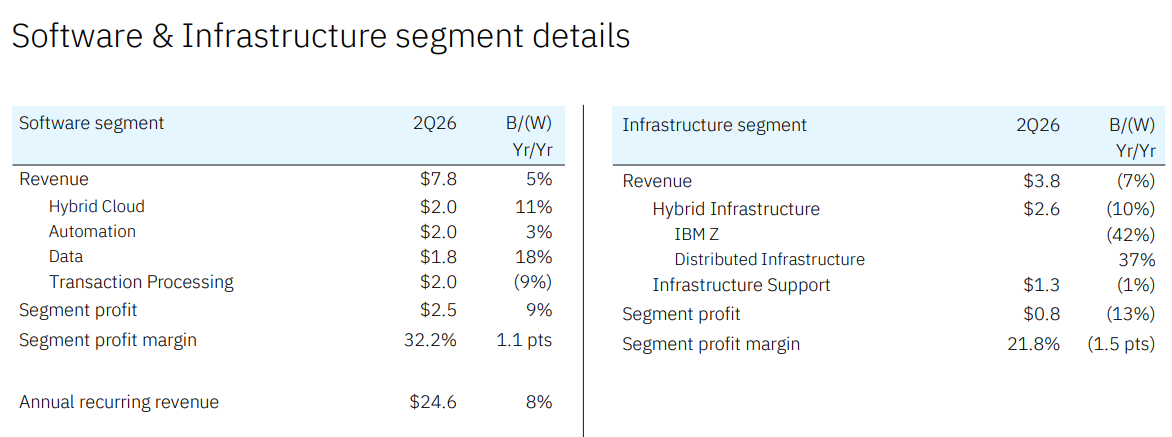
The company disclosed on its Q2 earnings call that 80% of its software revenue is recurring and that the total grew 8% in the last year to an ARR of $24.6 billion. While tech startups would scoff at 8% growth, it’s a big number for IBM.
There’s another part of IBM that is growing quickly: Distributed Infrastructure, which grew a stonking 37% in the quarter (compared to year-ago results), and closed the quarter with “approximately $500 million of backlog, [its] highest on record, supporting continued momentum.”
Now a $500 million backlog doesn’t move the needle that much at a company doing more than $17 billion in total quarterly revenue. But the segment’s future business implies that IBM has more than one way to profit from the AI boom. (Similarly, IBM consulting revenue, while all but flat, is now AI-driven, with generative AI representing “about 50% of [consulting] signings in the quarter.”)
Taken in aggregate, for IBM to grow faster it must either find net-new gold in the consulting and mainframe hills (perhaps future Z releases will boost results), or faster growth in its software business. Thankfully for IBM shareholders, its investments in inorganic growth are paying dividends. IBM has “complete conviction in the double-digit long-term software growth,” per its CEO, thanks in part to recurring software revenue growth at the company being “low single digit seven years ago.” That rising share of revenue that recurs is helping lift IBM: “We have a few different paths on how to get to 10%, not just one,” Krishna said, we can keep growing that part faster and that can approach not just 10%, but above 10%.”
Apart from recent performance, what can we infer from historical IBM results? The CEO said his company has raised its recurring/non-recurring software mix from 60/40 to 80/20. Which means the 20% of IBM software revenue that is not recurring must decline, which the CEO stated plainly on the call.
Even more, Krishna said that his company is “investing in capabilities that grow more at 15% to 20%,” which should provide a shot in the arm for IBM’s growth. Where is the company investing in higher-growth products? Let’s allow the CEO to explain:
As an example, we brought Hashi in and we accelerated it. We brought Confluent in and we accelerated it. Our organic watsonx portfolio is also growing at much higher rates than the aggregate. So that is the point that we are going to and we are not going to back off from our commitment of long-term double-digit for software despite the 2Q hiccup.
Given that the Q2 mess was driven by mainframe software sales and not the recurring stuff that appears to be the company’s growth engine, the company has a point.
But is it too dependent on purchasing growth (growing inorganically)? Its CEO surely thinks it is buying and accelerating external assets, not merely bolting them on as window dressing. But do you know what companies with growing free cash flow can do? Buy more stuff. There’s a point or two of growth hiding there, I reckon.
Perhaps the best question is whether or not IBM’s growing software products are set to accelerate in the AI era; is IBM well positioned to sell more of its winners, and expand more deeply into the AI trade?
If you close your eyes, clear out the deadwood from IBM’s forest and consider the trees left standing, they appear to have an open canopy above. And the more you believe in the AI boom, the more that IBM’s already-growing software products have room to run. Can IBM accelerate its software growth? So long as the economy doesn’t fall apart, I don’t see why not; if you believe that the company’s single-quarter mainframe miss is just that, and you have faith that the larger AI buildout/buying boom will continue, the investors likely overreacted to IBM’s dismal second quarter.
On the other hand, IBM doesn’t have the most market credibility when it comes to growth. That’s why it’s good it went early and hard with its bad news. Clear the decks. Eat the headlines. Suffer the selloff. Then get back to investing in higher-growth areas while gradually diluting the revenue-mix growth hit associated with legacy businesses. It’s not a one-quarter project, even if a single quarter’s results can throw the effort into doubt.