FastForward #83: My adventures in AI


Hi everyone. The colors are bursting outside my window as it's fall in its full glory in New England. Just a reminder if you're interested in having me moderate a panel or fireside or produce a sponsored video for your event, please drop me a line at ron@fastforward.blog. If you like what you see, please share this week’s edition with a friend, and encourage them to subscribe. It really helps.💌 Sign up here.
ForwardThinking 🤔
My adventures in AI
Those of you who follow me on LinkedIn know I report regularly about my tempestuous relationship with AI under the title 'My adventures in AI.' I have dabbled, struggled, experimented, raged and eventually found a somewhat peaceful way to coexist with these tools as I incorporate them into my daily work routines.
They help me with research, editing, creating business documents and other tasks that in many ways help me as a solo practitioner, and sometimes hinder, depending on the day. Trust me when I tell you, it’s easy to go down rabbit holes with these tools.
But until last week, when something shifted, I mostly asked AI to do stuff on my behalf. That is, until I had an AI epiphany. It started with a conversation with my son, who is doing some exciting things with agents. He suggested instead of asking the model to do stuff for me, I should have it interview me. This was a key shift.
I started with the goal of increasing my subscriber numbers, but what I ended up with was something else entirely.
Starting with a purpose
One of my problems as a newsletter writer is increasing subscribers. I got a flurry at launch, and then again when I relaunched in January as an independent publication, but just a handful a week since.
I decided to work with Claude, which is where I create my business documents like marketing one-pagers, invoices and contracts. But instead of telling it my problem, I directed it to ask me pointed questions, and thus began a conversation where I explained my blog and newsletter processes in more detail than I had ever considered — because this methodology forced me to think more deeply.
The end product was a document, which outlined some plans to increase subscribers, but also suggested several tools, including a business pipeline tracker, and that’s where my adventure truly began.
Building a tool to guide them all
I was most intrigued by what this business pipeline tracker would look like, and began building it over the next few days. It is a dashboard made of several tools including a business overview, a central calendar, invoice and expense tracking, an ad calendar and a conference and travel planner.
As I worked with it, I thought of new tools I wanted, and kept building. Eventually I asked for a similar tool to manage the editorial side of the house including newsletter and podcast management. I added a toggle to move easily between the two.
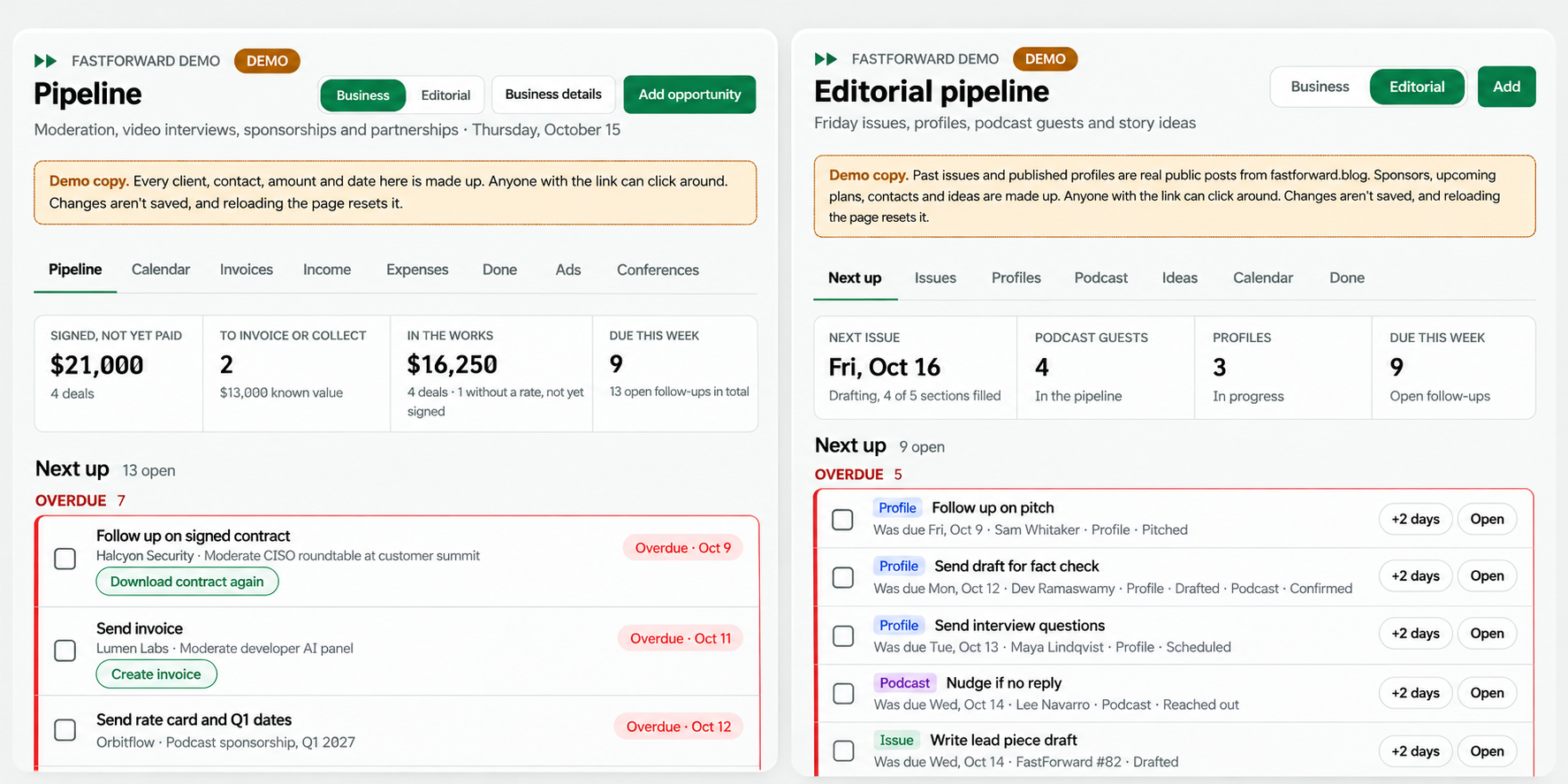
There was constant tweaking. For instance, everything has To Do lists associated with it, and as I refined the tool, I added ways to create my own items, to edit existing items and to leave notes as needed.
It immediately had a positive impact on me, and was the kind of tool I had been looking to build for over a year, and didn’t know it. For instance, when a new business opportunity comes along, I can tell Claude about it, and it creates a record in my pipeline, along with relevant documents, links, follow-up tasks and reminders.
When it's time to create a contract or an invoice, I click a button, review a form prepopulated with information from emails and generate the documents, complete with my electronic signature for contracts.
These are tasks I previously struggled to track with a combination of lists and my own memory. Having them organized in one place, with much of the tedious work automated, has taken a tremendous amount of stress out of running my business.
Making contingency plans
As I built this tool over the last week, I began to consider the magic of this exercise, that I could ask a model to interview me, take an idea that popped up from that process and turn it into a tool to manage my business, all without writing a line of code.
But I also worried about the security and privacy. It lives in a Claude artifact, not as a stand-alone app, something I haven’t attempted yet. I am careful about giving blanket permissions for moving files (usually only allowing one-time access), but it also needs access to my business email and calendar and that gives me pause, not enough to not do it, but I think about the implications of those kinds of broad permissions.

As I put this tool together, I quickly realized how important it has become to me in a short time, and I didn’t want to be completely beholden to Anthropic, so I produced several documents including a blueprint, detailed documentation and a backup of the technical files behind the dashboard. In this way, I can always pack up and leave if Anthropic gets too expensive or otherwise pisses me off (at least in theory; I haven’t tested this yet).
I back these documents up every few days manually and automatically on Sunday. I also created a demo version, so I could show it off without exposing my real data.
A matter of trust
One big issue I’ve found is that I don’t always necessarily trust the software to do what I’ve instructed it to do automatically, such as backing things up or checking off completed tasks. That means I’m constantly checking to see if it did it, or instructing it manually to do it anyway. I suspect this is a problem that a lot of knowledge workers face as they try to incorporate agents into their essential workflows.
The other issue is that I’ve become slightly obsessed with the process of building this thing, and I’ve found it’s taking so much of my time, I haven’t had as much time to write. I’m kind of hoping that once I have the baseline tool fully built, that will ease up and it will only require minor tweaking moving forward, but I don’t have any way of knowing that at this point. There's always something else to build, and once the switch has been flipped on, it's hard to turn it off.
Regardless, the real shift wasn’t that AI built me a dashboard. It’s that, for the first time, I used it to figure out what I actually needed, and it helped me build something pretty amazing without any coding skills whatsoever.
~Ron
What's new on the blog 📰
Qualcomm CIO Atilla Tinic is rethinking the IT playbook for the AI era
I spoke to Qualcomm CIO Atilla Tinic recently. We talked about how AI is forcing him to question long-held assumptions about how to run IT, including how companies use their data.
“I've done a 180 now, and I really believe your data lake or lakehouse is really your source of record for unified data going forward. And when you start to incorporate AI agents on top, they are more powerful in their capabilities when they have unified data that's trusted and curated that they can leverage.”
Your next tough work conversation could start with an AI avatar
I spoke to a couple of Synthesia execs recently about how they are using avatars to teach managers how to have tough conversations with employees. It lets them practice these conversations in a safe way before they meet with the employee.
Read the full story>>
Glasswing's Rudina Seseri says AI has changed the formula for startup success
When I spoke to Glasswing Ventures' co-founder and managing partner Rudina Seseri at TechCrunch Early Stage in 2024, she was already seeing how AI was changing the investing landscape. Today, she says that has become even more pronounced.
"You know, even two or three years ago, if a company went from zero to $1 million in ARR in its first year in the market, you'd be like, I have a unicorn in the making. Now that number looks more like zero to $2.5 million," Seseri said.

Atlassian and Expedia see experimentation as a key part of learning about AI
Last week at HumanX in Amsterdam I had the privilege of interviewing Avani Solanki Prabhakar from Atlassian and Chris Burgess from Expedia on a panel about their company's AI journeys.
A big part of it is understanding that with the rapid rate of change, experimentation is built into the process, and you are never really done.
This quote from Prabhakar kind of sums it up:
"I feel like the speed of change is so fast," she said. "The only way to learn more about AI is just by creating faster learning loops internally, and that's what we are seeing."
As Adobe embarks on a new era, it pushes deeper into AI-powered customer experience
When I interviewed Amit Ahuja, Adobe's SVP of CX products, it was before we knew his boss, Anil Chakravarthy, would be named CEO of the company, demonstrating the company's commitment to the enterprise side of the house.
As Adobe transitions to a new era, creative and enterprise need to work together, and change the investor narrative that Adobe (and other SaaS companies) are less relevant in the AI era. As Ahuja told me, it's not like Adobe just jumped on the AI bandwagon when ChatGPT came out. It had been using prior generations of AI for many years:
"Even before Sensei, we've been using kind of general purpose AI for ages here at Adobe, and we've been doing that obviously across Adobe, whether that's on the creative and professional side, whether it's on a document productivity side, or whether that's on the experience orchestration side."
News of the Week 📣
Workday is the latest enterprise SaaS company to embrace headless computing

Earlier this year, Salesforce announced Headless 360, its way of providing back-end access to the data on the platform without requiring a front-end. The company reiterated this position at Dreamforce last month. I wrote about it here and here.
But Salesforce is not alone in recognizing that the value of SaaS does not lie in the interface, but in the data being collected on the platform. Agents don't necessarily need an interface the way we do, and headless separates the two.
This week, at Workday Rising, the company announced a headless strategy of its own. It sees what Salesforce, ServiceNow and all the other major enterprise SaaS players see, that agentic access and human access are different and they require a different way of interacting.
The company's new platform that includes a headless option is called Trusted Agent Platform, and the idea is to give access to Workday HR and financial information in the way that makes the most sense for a given scenario, whether that's through the front end, via headless access on the back-end, or using Workday tools or external ones.
Of course, companies could be wary of giving agents, humans and other systems blanket access to sensitive HR and financial information. Workday says its existing permissions, approvals and audit trails will apply regardless of who or what is accessing it, and that includes headless.
“Headless can’t mean lawless,” said Workday CTO Gabe Monroy in a statement. “The rules for HR and finance already live in Workday, so customers don’t have to rebuild them for every agent they create.”
Egnyte gives AI agents better context with tighter control over what they can access

The news is full of agentic horror stories, of escaping sandboxes, and finding ways around guardrails. This is raising a persistent worry among security professionals: As agents proliferate in the enterprise, companies are struggling to find ways to keep them under control.
Even as this is happening, they also need to give the agents context to understand the business requirements and how to act on behalf of the business in a way that makes sense.
Egnyte, a company that focuses on working with content in a secure way, announced two new products this week designed to help. The first, Context Studio, gives customers a way to access the most relevant content stored on the Egnyte platform to give agents much-needed context with the goal of operating with more precision and intelligence.
The other piece, AI Control Center, gives organizations greater visibility into what agents are operating inside the company. It's important to understand, however, that it's only those agents interacting with Egnyte content, not every agent in the company.
That's a useful distinction because companies increasingly have agents operating across multiple systems, and controlling access to content in one platform doesn't necessarily give security teams a complete picture of what those agents are doing elsewhere.
Still, the company believes that the combination of these tools with other AI-assisted tools on the platform like AI Safeguards and AI workflow automation, gives customers more complete control over the agents interacting with content stored in Egnyte.
ServiceNow AI passports gives AI agents an identity that travels with them

When I was at SailPoint Navigate last week I learned a lot about the importance of identity in controlling agents. Agents have the unique ability to take on different identities as they move through a complex process and encounter other systems and agents, each with a different set of permission requirements.
ServiceNow announced a new tool this week to help called AI Passport that could work with SailPoint or any other identity vendor (or governance or enforcement mechanism for that matter). As the name implies the agent's identity and permissions travel with it in something akin to a passport. As it crosses system borders or accesses other agents, it presents its digital credentials enabling it to pass or not (at least in theory).
But AI Passport doesn't simply verify credentials. It's designed to actually restrict, redirect or terminate agents when they exceed their authorized permissions, which should please wary security and governance folks who could be worried about whether agents are operating beyond their purview.
AI Passport works in conjunction with ServiceNow's AI Control Tower, which issues the credentials and maintains an audit trail of agent activity.
While Workday and Egnyte focus primarily on governing agents within their respective ecosystems, including third-party agents, ServiceNow is taking a broader approach. Its new AI Passport is based on open specifications and is designed to govern agents across the enterprise, regardless of whether they're connected to ServiceNow.
Whether this will all work as described will have to wait, however, because the company has indicated it won't be available until sometime in the fourth quarter this year.
Disclosure: SailPoint paid me to produce a sponsored video at its Navigate conference last week. The company had no input into this article.
What I'm reading 📚

Amazon has over 1 million robot workers. What’s next for human employees?
~By Jeremy Hsu, Ars Technica
Companies rushed in on AI. Now some are pulling back
~By Taylor Talford, The Guardian
Why Is Tech Billionaire Marc Andreessen So Mad?
~By Austin Carr, Bloomberg
What I'm watching 📺
Stop Selling AI as Efficiency: Start Leading It as Human Growth with Elisa Camahort Page
~Gut + Science podcast
Look who's talking 👄
"An agent that's not grounded in business rules might move fast, but it is essentially lawless."
~Workday CEO Aneel Bhusri at the Workday Rising keynote this week