My adventures in AI


Those of you who follow me on LinkedIn know I report regularly about my tempestuous relationship with AI under the title 'My adventures in AI.' I have dabbled, struggled, experimented, raged and eventually found a somewhat peaceful way to coexist with these tools as I incorporate them into my daily work routines.
They help me with research, editing, creating business documents and other tasks that in many ways help me as a solo practitioner, and sometimes hinder, depending on the day. Trust me when I tell you, it’s easy to go down rabbit holes with these tools.
But until last week, when something shifted, I mostly asked AI to do stuff on my behalf. That is, until I had an AI epiphany. It started with a conversation with my son, who is doing some exciting things with agents. He suggested instead of asking the model to do stuff for me, I should have it interview me. This was a key shift.
I started with the goal of increasing my subscriber numbers, but what I ended up with was something else entirely.
Starting with a purpose
One of my problems as a newsletter writer is increasing subscribers. I got a flurry at launch, and then again when I relaunched in January as an independent publication, but just a handful a week since.
I decided to work with Claude, which is where I create my business documents like marketing one-pagers, invoices and contracts. But instead of telling it my problem, I directed it to ask me pointed questions, and thus began a conversation where I explained my blog and newsletter processes in more detail than I had ever considered — because this methodology forced me to think more deeply.
The end product was a document, which outlined some plans to increase subscribers, but also suggested several tools, including a business pipeline tracker, and that’s where my adventure truly began.
Building a tool to guide them all
I was most intrigued by what this business pipeline tracker would look like, and began building it over the next few days. It is a dashboard made of several tools including a business overview, a central calendar, invoice and expense tracking, an ad calendar and a conference and travel planner.
As I worked with it, I thought of new tools I wanted, and kept building. Eventually I asked for a similar tool to manage the editorial side of the house including newsletter and podcast management. I added a toggle to move easily between the two.
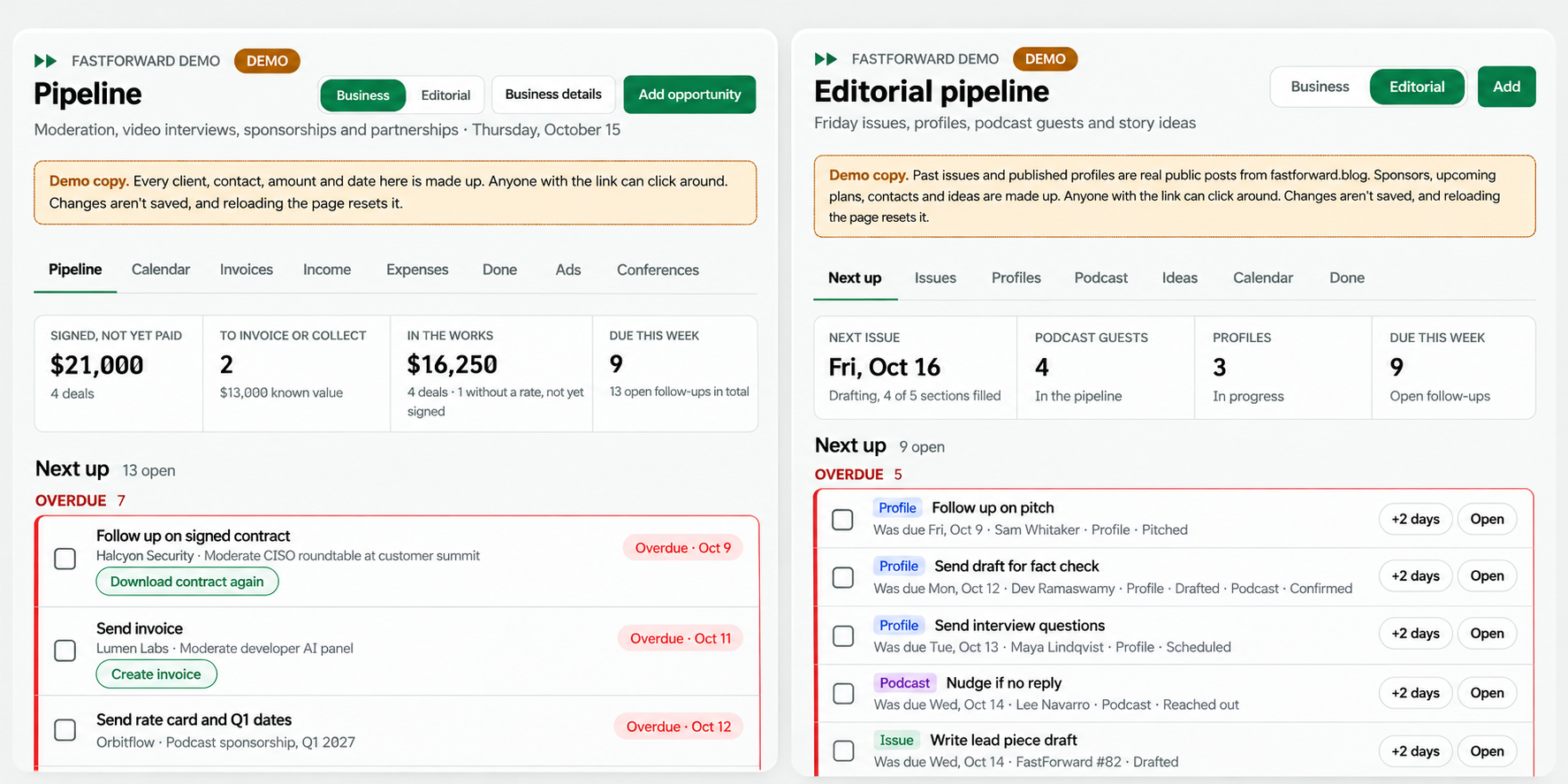
There was constant tweaking. For instance, everything has To Do lists associated with it, and as I refined the tool, I added ways to create my own items, to edit existing items and to leave notes as needed.
It immediately had a positive impact on me, and was the kind of tool I had been looking to build for over a year, and didn’t know it. For instance, when a new business opportunity comes along, I can tell Claude about it, and it creates a record in my pipeline, along with relevant documents, links, follow-up tasks and reminders.
When it's time to create a contract or an invoice, I click a button, review a form prepopulated with information from emails and generate the documents, complete with my electronic signature for contracts.
These are tasks I previously struggled to track with a combination of lists and my own memory. Having them organized in one place, with much of the tedious work automated, has taken a tremendous amount of stress out of running my business.
Making contingency plans
As I built this tool over the last week, I began to consider the magic of this exercise, that I could ask a model to interview me, take an idea that popped up from that process and turn it into a tool to manage my business, all without writing a line of code.
But I also worried about the security and privacy. It lives in a Claude artifact, not as a stand-alone app, something I haven’t attempted yet. I am careful about giving blanket permissions for moving files (usually only allowing one-time access), but it also needs access to my business email and calendar and that gives me pause, not enough to not do it, but I think about the implications of those kinds of broad permissions.

As I put this tool together, I quickly realized how important it has become to me in a short time, and I didn’t want to be completely beholden to Anthropic, so I produced several documents including a blueprint, detailed documentation and a backup of the technical files behind the dashboard. In this way, I can always pack up and leave if Anthropic gets too expensive or otherwise pisses me off (at least in theory; I haven’t tested this yet).
I back these documents up every few days manually and automatically on Sunday. I also created a demo version, so I could show it off without exposing my real data.
A matter of trust
One big issue I’ve found is that I don’t always necessarily trust the software to do what I’ve instructed it to do automatically, such as backing things up or checking off completed tasks. That means I’m constantly checking to see if it did it, or instructing it manually to do it anyway. I suspect this is a problem that a lot of knowledge workers face as they try to incorporate agents into their essential workflows.
The other issue is that I’ve become slightly obsessed with the process of building this thing, and I’ve found it’s taking so much of my time, I haven’t had as much time to write. I’m kind of hoping that once I have the baseline tool fully built, that will ease up and it will only require minor tweaking moving forward, but I don’t have any way of knowing that at this point. There's always something else to build, and once the switch has been flipped on, it's hard to turn it off.
Regardless, the real shift wasn’t that AI built me a dashboard. It’s that, for the first time, I used it to figure out what I actually needed, and it helped me build something pretty amazing without any coding skills whatsoever.
~Ron