
FastForward #76: Whose data is it anyway?


Hi everyone. One thing you can say about this summer is that the news never slowed down. It just kept coming, and I kept reporting and reacting to it to the best I can. If you like what you see, please share this week’s edition with a friend, and encourage them to subscribe. It really helps.💌 Sign up here.
ForwardThinking 🤔
Whose data is it anyway?
And every word you say
Every game you play
Every night you stay
I'll be watching you
~Police, Every Breath you Take
It's not exactly a secret that as we move around the internet, interact with search engines and seek guidance from AI bots, we spread a deep data trail as we go, one that has become increasingly valuable. That's because AI models are data-hungry monsters.
One of the big questions facing us as we plunge deeper into the age of AI is who owns the data that companies are collecting on us. That came into glaring focus this week when Google announced it was buying Spirit Airlines' internal business and employee data for $10 million. It's worth noting that the haul doesn't include passenger profiles, PII and loyalty-program records, but what was included was a doozy.
That data set includes "decades of payroll, travel and recruiting files, along with about 100 million emails, 80,000 email accounts and millions of additional digital items," per the Wall Street Journal. If I were a former employee, I would be pissed too.
Spirit Airlines' business, you may recall, went up in flames in May when the 40-year-old airline, which had declared bankruptcy last year, shut down after a $500 million government bailout failed to materialize. That meant a court would decide how the various pieces of the business would be sold off to pay off creditors. It turns out one of those valuable assets was the company's data set. As Dan Shaughnessy would say, "Swell."

The airline's flight attendants union didn't take the news well, protesting to the bankruptcy court that the privacy of former employees was at risk, causing a delay, at least for the moment, while the court looked at the union's protest.
Google for its part says the data will be cleaned and anonymized by a third-party service, and there is really no reason for the former employees' concerns. Nothing to see here, right? But how clean is clean? A third party is supposed to certify that the data meets privacy requirements, but the employees themselves have no way of knowing how thorough that process will be, and therein lies the problem.
As I wrote on LinkedIn this week, this is precisely why companies owning our data without limits is so dangerous. If you have no control over your data, and the data is an asset to sell off for parts, it can be used in ways you never intended.
Data ownership in the brave new world
The data ownership question is not new. For years now in my conversations with startup founders, they would talk about the product they were creating, but often talk about how the data created by users by the simple act of using the program, might be more valuable. That was true a decade ago, and it's even more true now.
Among the data control advocates is the founder of the World Wide Web himself, Tim Berners-Lee. In a 2022 interview on Northwestern University's Untangling the Web podcast, he put it this way: "We believe philosophically that everybody should be able to control your own data." He helped found a startup called Inrupt in 2018 to make that happen.
In a 2018 blog post announcing the launch of his company and its open source project, Solid, Berners-Lee wrote:
Imagine if all your current apps talked to each other, collaborating and conceiving ways to enrich and streamline your personal life and business objectives? That’s the kind of innovation, intelligence and creativity Solid apps will generate. With Solid, you will have far more personal agency over data - you decide which apps can access it.
(You can learn more about how Inrupt works in my 2020 TechCrunch story here.)
Perhaps Berners-Lee was simply ahead of his time. That vision is remarkably current in today's agentic environment, where software and agents are expected to communicate with one another. It also shows that with some imagination, we can find ways to keep control of our data, and as Berners-Lee put it, decide how it gets used.
Unfortunately, Berners-Lee's vision has not taken off the way the web itself did, and if the market can't create a viable solution, it may be left to governments to legislate one. In the meantime, we are left with situations like Spirit, where a company's data gets liquidated by creditors while the people who created it have no say in the matter.
~Ron
What's new on the blog 📰
IBM and OpenAI hope their partnership is the beginning of a beautiful friendship
IBM's partnership with OpenAI may be a no-brainer, but it should help both companies.
Note that I originally wrote about this partnership in a LinkedIn post, then expanded that in a News of the Week piece in FastForward # 75. This analysis takes a deeper look.
The repurposing of content across different platforms is intentional and part of my ongoing strategy to reuse content wherever possible.
Read the full story>>
In the debate over open-weight models, Capital One makes a different case
There is a battle raging in tech over the use of open weight models. On one side, the AI labs, the same ones telling us that their models got loose and hacked several websites, say the open weight models are unsafe.
Other companies argue that they need to be able to customize models, and the proprietary ones from those same AI labs make that much more difficult to do.
I spoke to Milind Naphade, SVP of AI foundations at Capital One, whose company doesn't care about the debate. They just need the flexibility that open weights provide to take advantage of their data.
"To do all that needs open-weight models, we just cannot do that without them. And why is that important? Because that's the only way that we can fulfill our twin mandates of delivering high accuracy with regulatory compliance," he said.

AI is rewriting the CISO job description
In the final part of my 3-part video interview series with Zscaler's Swamy Kocherlakota, we talked about how AI is changing the role of the CISO.
"So, in my mind, the CISO now has to evolve to become much more application-centric, data-centric, above and beyond the infrastructure centricities that they have. So, there's a new breed of CISOs that will come in as a result of this," he said.
AI has put cloud growth back into overdrive
Remember back in 2023 when the cloud market was in the doldrums and AWS revenue growth plunged to 12%? Hard to believe now. I take a look at just how much the AI boom has boosted cloud infrastructure revenue in the ensuing years.
As I wrote:
Three years after cloud growth appeared to be settling into middle age, the Q2 2026 numbers show just how dramatically AI has changed the trajectory of the market. The cloud infrastructure market grew 43% in Q2 to reach $143 billion, according to Synergy Research, the highest growth rate in eight years.
After IBM stock takes a beating, what comes next?
In my latest collab with Alex Wilhelm from the Cautious Optimism blog, my former TechCrunch colleague and I dig into IBM's disastrous second quarter earnings report, one so bad that CEO Arvind Krishna sent out a letter to shareholders before the report came out to soften the blow and warn them what was coming.
After that letter was delivered, investors reacted badly with a record one-day stock price drop of 25%. The question is, was this an over-reaction to one bad quarter or a more dangerous signal.
News of the Week 📣
Salesforce expands headless capabilities across the platform

This week Salesforce announced it was expanding its Headless 360 program with the most important element being the Headless 360 MCP server, which enables agents to access Salesforce platform services via a standard MCP protocol.
In April, I wrote a commentary called Get ready for headless everything in which I surmised that given the nature of agents, for software vendors to survive, they would need to open up the back end to make it accessible to agent traffic. While humans need a GUI, digital elements typically don't. I wrote the article after Salesforce released the first piece of this approach.
This is much broader, and it's an acknowledgement that SaaS companies have to make their software available to agents, who will increasingly end up being the "user."
As Salesforce wrote in the announcement: " For decades, enterprise software has been organized around applications. Headless 360 changes that by systematically transforming every Salesforce cloud into reusable enterprise capabilities that can be securely consumed by AI agents, applications and experiences.
Jason Andersen, an analyst at Moor Insights & Strategy sees this as important step forward for the company, one that alters its agentic approach in a fundamental new way. "Instead of treating agents as a threat to the SaaS business, Salesforce has made its walled garden more permeable, effectively promoting agents to a new user archetype," Andersen told FastForward. "Doing this will further democratize Salesforce apps and data for both existing and new users and unlocks Salesforce's value beyond its own solutions."
And that's really key to the survival of the company in the agentic age. If the hype is true and agents will be working directly with software without our help, then being able to access the software directly in a digital way is going to be key.
It's worth noting, as is typical for Salesforce, this product is not quite ready yet, but is available in beta.
Adobe report finds consumers increasingly using LLMs for travel plans

Last spring when I was making travel plans, I was looking for an Airbnb. Typically I like a place close enough to the main drag to walk to, but not in the middle of it, because it tends to be crowded and loud.
Unfamiliar with the area we were traveling, I fired up ChatGPT and asked about the city, the area we were staying and how close it was to where the action was. It was extremely helpful. We made our choice and were quite happy with it.
It turns out I'm not alone in using LLMs for this purpose. People are increasingly turning to bots for help. A July Adobe report found that traffic to travel websites from LLMs was up 119% year over year and since Adobe began tracking this data in October 2024, the number of clicks to travel sites is up an astonishing 1,822%. Of course, it's growing from a small percentage of traffic, but it shows that LLM usage for travel plans is growing fast.
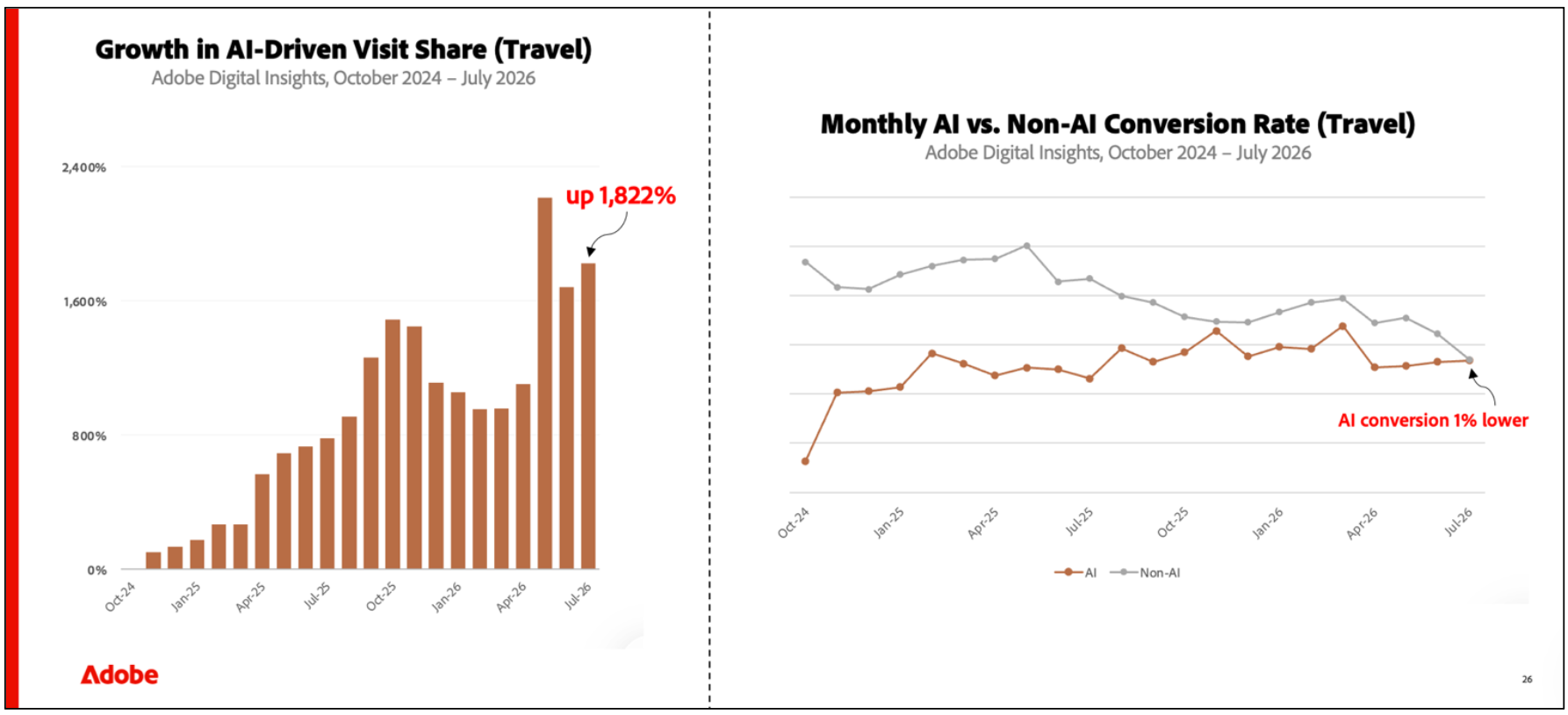
It's also showing up in other online sales, but travel appears to be the most pronounced example. Adobe points out that in spite of the positive data, many websites still have visibility gaps when it comes to LLMs and this data shows how important is to begin optimizing for the models.
Notably, Adobe points out that AI traffic is now converting almost exactly the same as traditional traffic with just a 1% difference, so it's worth paying attention to.
GitHub response to Aug 17 outage: We couldn't handle the traffic

It's been a rough week at GitHub. The company experienced an outage on Monday that lasted for almost 8 hours. For customers who rely on GitHub Copilot, it must have been agonizing. But that wasn't the only service impacted. Others, by the company's own account, included github.com, authentication, GitHub Actions, APIs, pull requests and issues. Ouch!
The precise time was 7 hours and 47 minutes, and to its credit the company published a blog post on Thursday explaining what happened. The problem is that the explanation didn't land well. It comes down to basically we had too much traffic and we couldn't handle it.
As we all know by now, AI coding has accelerated code creation, which has an impact on everything else in the pipeline. GitHub has indeed been flooded with new code. Kyle Daigle, GitHub's COO explained just how much AI has increased traffic to his platform in a recent post on X. "GitHub Actions has grown from 500M minutes/week in 2023 to 1B minutes/week in 2025, and now 2.1B minutes so far this week," he wrote.
And that's just one stat. In this week's blog post, the company explained that its commits have doubled, just since April, from 1.4 billion to 2.9 billion (and a lot of that is probably AI-generated slop). But, and it's a big one, the company still has to figure out how to deal with it.
Many people on HackerNews weren't buying that explanation, or were terribly sympathetic to GitHub's increased usage, saying (quite rightly) that GitHub is owned by Microsoft and they should have accounted for the necessary resources. This comes on the heels of another outage on August 6th. It's no wonder users are losing patience.
The blog post concluded: "The developer community depends on GitHub to build, ship and operate their work. That is only possible if you can rely on us, and on August 17, you couldn’t." They're right, and they have to put their money where their mouth is and fix it!
What I'm reading 📚

Your AI agents won't fail. Your processes will
~By Pam Baker, InformationWeek
Why a Payments Giant Is Paying $7 Billion for the ‘Stripe of AI’
~By Kate Clark, Wall Street Journal
GOP warns AI companies that data centers are politically radioactive
~By Alex Isenstadt, Axios
What I'm watching 📺
Will AI Be Good or Bad for Young Professionals?
~Fortt Knox Innovation Lab
Look who's talking 👄
"It's a win for customers as they need help to implement AI successfully, a win for OpenAI, as it needs to move to the enterprise and does not want to build up the services for that (as they are margin dilutive) and a win for IBM, which needs to create consultant revenue potential and direct revenues."
~Holger Mueller, Constellation Research analyst, on the IBM-OpenAI partnership as told to FastForward.