
AI has put cloud growth back into overdrive


Think back, if you will, to three years ago. Yes, ChatGPT had been released the prior year, but cloud companies weren't seeing much benefit yet. In fact, the market was in a lull. AWS growth plunged to 12% for Q2 and Q3 that year, growth numbers so abysmal it's hard to imagine now. You may recall companies were cutting back on cloud spending, and pundits (like me) were suggesting that AWS's glory days might be behind them.
What we didn't know was things were about to change in a big way and a new source of growth was coming. It sure didn't feel like that back when AWS had 10 straight quarters of growth under 20%. In many ways, it felt like a normal maturation. Nobody grows over 20% forever, and AWS was (and remains) the clear market leader in the cloud infrastructure space. It was the first (20 years ago this year in fact), and it took Google and Microsoft some years to rev up.
Of course, the two upstarts were growing faster. It's easier to grow from a smaller number to a larger one, than it is once you get to a certain size. AWS was simply running into the law of large numbers.
How AI flipped the script
As AI began to take off, we quickly learned that it had an unusually large hunger for compute, chips and memory. Demand for infrastructure services increased dramatically as companies, afraid of missing out, took the AI plunge, and that began showing up in growing cloud infrastructure revenue.
Three years after cloud growth appeared to be settling into middle age, the Q2 2026 numbers show just how dramatically AI has changed the trajectory of the market. The cloud infrastructure market grew 43% in Q2 to reach $143 billion, according to Synergy Research, the highest growth rate in eight years.
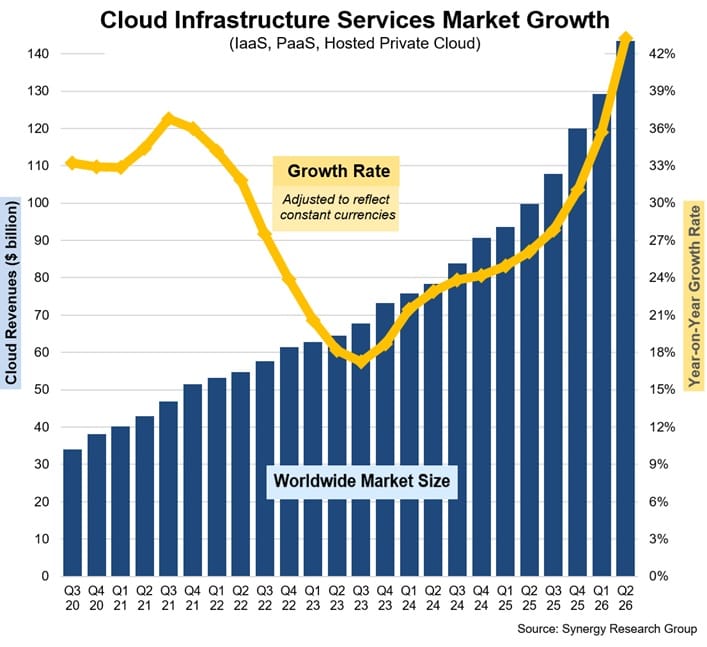
The Big 3 all had tremendous quarters. AWS revenue grew 37% year over year, while Azure revenue was up 43% and Google Cloud an astounding 82% (keeping in mind they count Google Workspace revenue too).
Amazon led the way with 28% of the market, per Synergy, followed by Microsoft at 20% and Google at 15%. Oracle remains a distant fourth at 4%.
A good chunk of this growth was being fueled by one thing and one thing only. "AI technology has lit a fire under the cloud market and is now driving unprecedented growth. GenAI-specific cloud services are growing at 165% year over year, but equally importantly, AI technology is enabling enhanced functionality and increased growth across a much broader range of cloud services," Synergy chief analyst John Dinsdale wrote in the firm's quarterly report.
The capex problem
I've said it before, but it bears repeating, this kind of growth from a market this mature is remarkable, but it comes at a cost. Each of the companies is also reporting surging capex spending to try to keep up with this demand.
Amazon reported more than $54 billion in capital expenditures in the quarter, roughly $10 billion more than the prior quarter. Microsoft reported capex of almost $36 billion, up about $5 billion, while Alphabet reported approximately $45 billion, almost $10 billion more than the prior quarter.

Yet they still don't have enough. "They have more demand than supply. They're leaving money on the table because they don't have enough capacity," IDC analyst Dave McCarthy told FastForward.
Perhaps that's why capex has been rising along with cloud revenues, margins, and profits. For example, Google Cloud parent Alphabet doubled its capex outlays from Q1 2025 to Q1 2026; over the same time period, Google Cloud’s growth rate soared from 28% to 63%, its operating margin nearly doubled and its profitability more than tripled. AWS and Azure have experienced similar growth.
With every major cloud provider telling investors in their most recent earnings reports that they can't build capacity fast enough, it's likely that present-day investments should bear similar fruit next year, that is, unless the growth slows and they are left with more capacity than they can sell.
And that's the problem for these companies. They are building out this massive capacity with no way of knowing where the market is going long-term. It's an enormous gamble because if growth slows, they will be stuck holding the bag.
Editor's Note: My buddy Alex Wilhelm contributed to the capex section. Check out his in-depth look at capex spending in the Cautious Optimism blog.