
FastForward #64: Hope for grads despite AI hysteria

I spent the early part of the week in Boston at IBM Think. Boston is a town with a lot of colleges. The talk of AI mixed with upcoming graduations got me thinking about entry level jobs. If you like my newsletter, please share this week’s edition of FastForward with a friend, it really helps.💌 Sign up here.
ForwardThinking 🤔
Hope for grads despite AI hysteria
As any sports fan knows, teams thrive when they have players with a variety of experience. Having a pipeline of younger players in various stages of development helps give the team new blood, cheaper talent and a way to transition from older players as they move on or retire.
Organizations are no different. I'm on record as saying that AI is an excuse and not the reason many companies are conducting massive layoffs this year. They are using it for cover, but anyone who uses this technology on a regular basis knows it's not replacing experienced workers. Sure it can augment them, but straight out replace them? That's a stretch.
But one area where automation could have a real impact is entry level jobs. With college graduations coming up, I've been thinking about the lack of entry level jobs and what it could mean to large organizations in the years ahead. Entry level jobs are where people develop judgment and learn the fundamentals of good work. If working with AI requires a certain level of understanding to judge the quality of the output, if we don't train people in those fundamentals, who's going to be the judge?
My friend, Robert Rose, chief strategy officer at the Content Marketing Institute, recently did a series of podcasts based on his firm's annual marketer's survey. Among the results that stood out was that one in three companies reported reducing entry level hiring. He sees this as a big problem and I agree. "If we chop that off, three years from now, who are we left with? There is no more pipeline of those people,” Rose said.
As he pointed out, entry level jobs have always been ripe for automation, whether marketing or other departments, but they have also provided an avenue for young people to learn how businesses run, how to work with customers and how to hone their own ideas.
Refreshing the pipeline
We are starting to see companies recognize that without entry level people, there's going to be a dearth of experienced employees down the road.
- AWS: CEO Matt Garman announced that the company intends to hire 11,000 engineering interns this year, a level the company says is in line with recent years.
- Salesforce: The company plans to hire 1,000 college grads and interns for AI‑related roles through its new Builder program.
- IBM: Big Blue has committed to tripling its entry‑level hiring in the U.S. this year compared with prior years, though it hasn’t disclosed a precise headcount.
With more than 280,000 employees worldwide, IBM’s pledge suggests it could end up with a much larger entry‑level cohort than Salesforce, though the company wouldn't provide a specific number when I asked.
At a media briefing during IBM Think this week, CEO Arvind Krishna pushed back on the notion that AI-driven productivity means companies need fewer workers. He argued it's actually the opposite, that more productive companies historically capture more market share and need more people to innovate and serve clients, and using AI as an excuse to hire fewer people is ceding the market to competitors.
"If you're thinking of cutting down all hiring and sort of not refreshing your workforce, you're implicitly arguing that you think you're going to be on the losing side of AI as opposed to the winning side."

Younger people are cheaper than experienced workers, often more flexible and come in with a fresh perspective and a native understanding of newer technologies that more seasoned employees need to learn.
Krishna sees young people not only bringing these qualities, but also, with AI, the potential to get up to speed understanding the business much faster than in prior times. "If AI can also make the entry level hire within a few months, be as good as the person with five or 10 years of experience, we should be doubling down on that kind of individual."
While his estimate could be more than a tad optimistic, AI does have the potential to make younger workers more competent more quickly. And organizations who cut that pipeline for short-term gains will be feeling the pinch before too long when there is no longer a bench to replace the starting lineup.
~Ron
What's new on the blog 📰
Twilio finds its place in the AI stack
Twilio CEO Khozema Shipchandler took over in 2024 when the company was under pressure from activist investors.
He knew there was a lot of work to do, and he wanted to run the company with more rigor and discipline. He's positioned Twilio squarely in the AI stack and has seemingly righted the ship. In its most recent quarter, reported this month, revenue was up 20% YoY and the activists? They're long gone.
"I think this is what we were always meant to build. We may not have known it every step of the way because we couldn't see AI five or seven years ago, but now that we're here, it's ours to go get and we're going to get it."
AI gives cloud vendors a major second act
In mid-2023, the cloud market was in the doldrums. Companies were cutting back on cloud spending and growth was slowing across the board. Then generative AI came over the horizon and gave cloud computing vendors a major second act.
I dug into the cloud numbers to see just how dramatic the turnaround has been.
How Google Cloud’s head of startups thinks about building companies in the AI era
Ahead of Google Cloud Next, I interviewed Darren Mowry who runs their global startup program. Mowry has a unique perspective having also worked at AWS and Microsoft in his career.
He says that AI coding has changed the speed at which companies can build, but it hasn't altered the fundamental requirements of building a business.
"There have been moments during the hype cycle where people were saying, let's throw the fundamentals out, but there's always a return to, do you have clarity of vision? Do you know who your customers are? Do you know what problem you're solving, and do you have a pathway to profitability? We always come back to that," he said.

Why AI projects get stuck in testing hell
Enterprises struggling to implement AI, often get stuck in an endless testing loop. When that happens, you start to lose the very efficiency gains AI was supposed to deliver in the first place. I moderated a panel at HumanX with Prukalpa Sankar, CEO and co-founder at Atlan and Brad Menezes, CEO and co-founder at Superblocks on how a strong governance foundation can get you out of testing hell and into production faster. This story came from that panel.
Google adds agent control layer, and lock-in debate begins
I returned to my tried and true analyst reaction piece and looked at the impact of Google’s expanded Gemini Enterprise Agent Platform. I spoke to three analysts to get their take.
A big question involved vendor lock-in and this is where the three had the most differing opinions. Jason Anderson, an analyst at Moor Insights & Strategy who covers all things cloud and AI, says all platforms are likely to have some bias built in, but sees Google as the most likely to lock in customers at the moment.
"But in terms of 'openness' I'd say that while most of these platforms are biased, Google's may be slightly more so right now," he said.
Why video and images present such a challenge to enterprise AI teams
Enterprises face unique challenges when it comes to understanding, managing and processing unstructured data like images, sound and video. One of the problems is that video is just so complex. As Soyoung Lee, co-founder and head of GTM at Twelve Labs pointed out, it's hard for models to process everything that's going on in video content.
"Video is a uniquely human concept, where it's so similar to the real world. It has sound. It has visuals. It has language. You have to understand how things change over time and connect everything to understand the narrative," she said.
News of the Week 📣
ServiceNow wants to help control AI agents across the enterprise
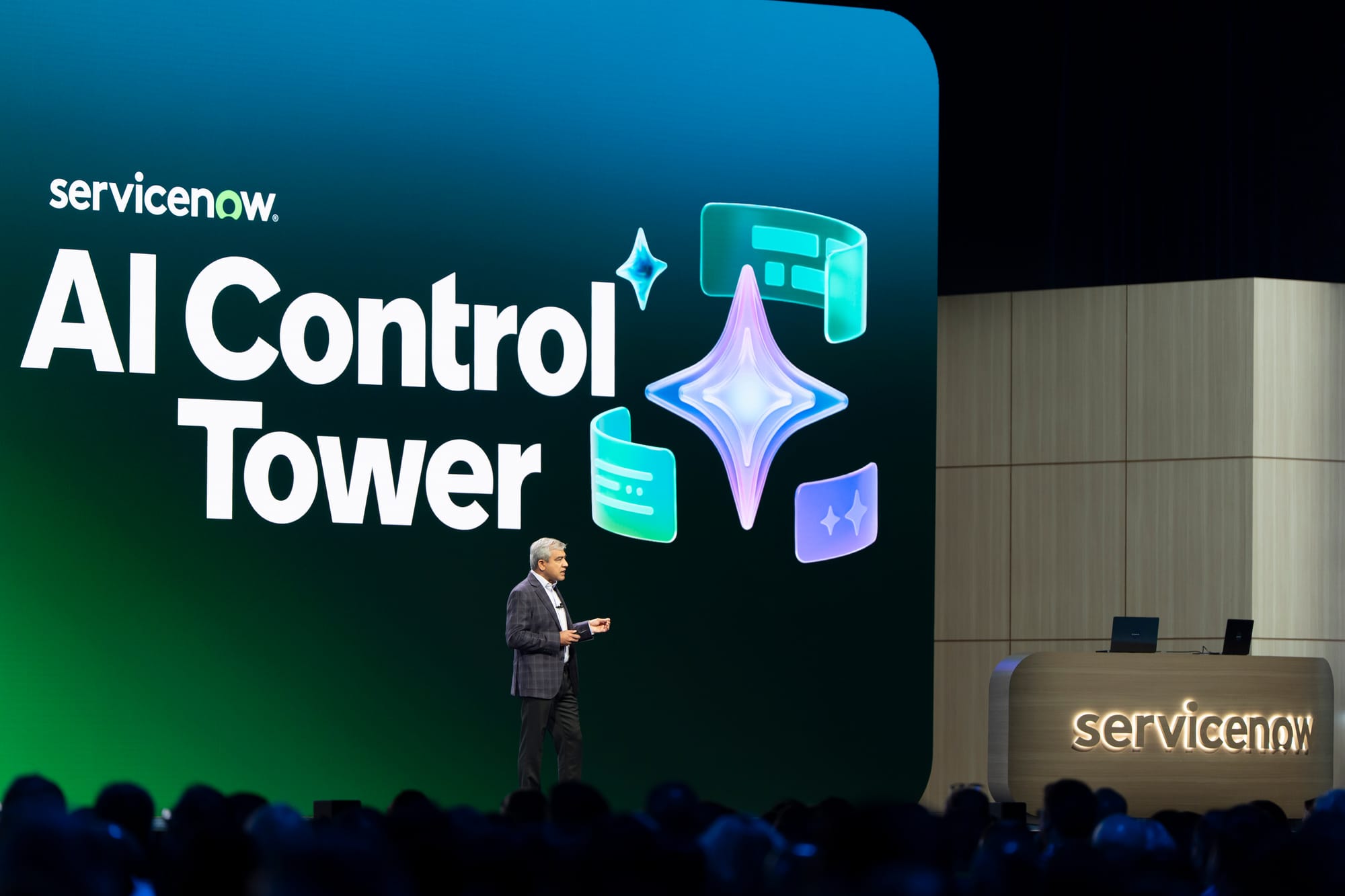
Since generative AI emerged several years ago, there's been a persistent need for enterprise tools to manage, secure and govern it as AI gets distributed across an organization. This is especially true with agents, AI-driven automations. ServiceNow made it clear this week that it wants to be more than the SaaS company managing IT service management. It wants to manage the entire AI stack.
CEO Bill McDermott speaking on CNBC's Fortt Knox positioned his company as that orchestration layer. "We are the control plane for the AI experience in the enterprise,” McDermott told CNBC's Jon Fortt. He said that meant they were managing both ServiceNow agents and those from other vendors.
Whether it can pull that off, that's the messaging, and the company announced a couple of ways to get there. The first is the Agent Control Tower, which was introduced last year as a way to control ServiceNow's agents. This year it expanded to include others from outside the organization.
The company also introduced an AI-powered search tool called Otto that helps employees find the information they need using natural language, your standard generative AI layer on top of all the data companies like ServiceNow are managing inside their platform.
The company is aiming high and taking a big agentic swing. So far it has not been rewarded by the public markets, but McDermott is confident that will happen as the agentic AI market develops further and ServiceNow gets a piece of that action. Time will tell if he is right.
Atlassian capitalizes on its data advantage

Atlassian held its Team customer conference this week and it made clear it has a data advantage and it wanted to make that data available to agents via an MCP server. The company collects its vast supply of data in a graph database called Teamwork and it is opening that up for the first time.
"If you think about it, we have over 150 billion objects and relationships that are basically all the data customers have trusted us with over the last 20 years of our operation," Jamil Valliani, head of product, AI told FastForward. "We're showing customers just how powerful that context is, both when we deliver a solution for them, and also when they're able to go and harness that context for their own applications."
Atlassian is betting that by giving customers and third-party providers access to that graph, they will build applications based on that data and take advantage of the context that this data can give organizations, something competitors can't really do.
SAP makes a couple of big acquisitions as it tries to turn stock around

It hasn't been a great time for SaaS stocks as we've written (here, here and here), but the market has been particularly brutal to SAP with the stock price down around 40%, trading at 52-week lows. When that happens companies try stuff to get the market's positive attention again. This week SAP announced a pair of acquisitions.
For starters, it announced it was acquiring Dremio, which was once valued at $2 billion, but that was in early 2022 when money was still cheap and everyone was optimistic. While the companies did not share a price, it's probably fair to say it wasn't anywhere near that high value mark from four years ago.
But with Dremio, SAP gets its own data lakehouse, which should enable it to compete on some level with Snowflake and Databricks and give customers a way to bring together, not only SAP data, but also third party data, and query it.
The other company was Prior Labs, a German startup building tabular-based foundation models. The tabular part is important because this is something I spoke to Walter Sun, who runs AI at SAP, about last year. "We're building an SAP foundation model, which is different from large language models. It's going to supplement LLMs and allow SAP customers to access and leverage business data. This business data, which we consider mostly tabular data, is more difficult to process."
Now, the company has purchased a dedicated model maker to help and plans to invest $1 billion over four years in the company's technology. That may sound like a lot, but it's small potatoes compared to most numbers associated with AI investment. So far, at least, investors do not appear to be wowed by these moves, but it could be too early to draw any firm conclusions.
What I'm reading 📚

Tech has been killing my jobs for decades. I'm still here.
~By Sharon Goldman, AI Side Notes with Sharon Goldman
AI's unit economics are broken — and your cloud bill is going to prove it
~By Tomasz Wiśniewski, Tomasz Wiśniewski Blog
Bret Taylor’s Sierra raises nearly $1 billion months after last capital push
~By Kate Rooney, CNBC
What I'm watching 📺
Before There Is Proof: Build a Startup Story That Shows You Can Execute
Walter Thompson, Fund/Build/Scale
Look who's talking 👄
"By 'broken' I mean the simple thing: the prices people pay today, the plans the vendors sell today, and the capex projections funding all of it do not reconcile to a profitable business at scale. Somebody downstream is going to absorb the difference. The interesting question is who, and when."
~Tomasz Wiśniewski, AI's unit economics are broken