
AI gives cloud vendors a major second act


In the middle of 2023, the cloud market was fading. Companies had tired of big bills and they were looking to cut back on their usage. Amazon, the original cloud infrastructure vendor, was experiencing its lowest growth rates in years, dropping all the way down to 12% YoY in mid-2023.
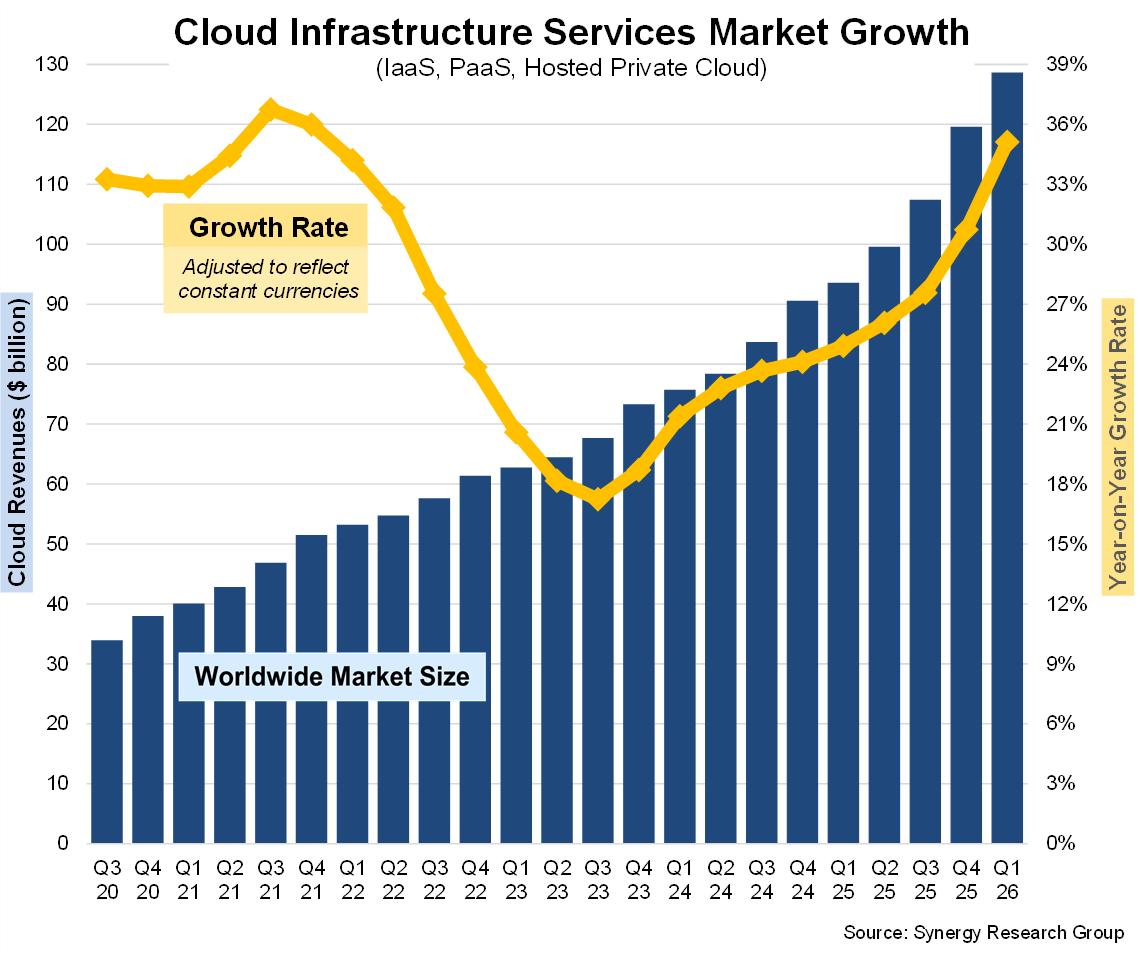
As the image below illustrates, the market growth rate was increasingly lethargic in 2023, bottoming out in Q3 before starting an upward trend that continues to this day and almost equals the peak in 2021. For a maturing market, this sudden about-face is remarkable.
What nobody could have foreseen at that moment was that the cloud business was about to get a major shot in the arm from generative AI. Suddenly data center investment and demand for cloud infrastructure went through the roof.
While everyone is doing great, I want to concentrate on Amazon for a moment. A company once written off as being too far behind in the AI game has suddenly found itself a big beneficiary of the changing market.
What's stands out is that Jamin Ball reported that the company's revenue grew 28% year over year in the most recent quarter, putting it on an eye-popping $150 billion run rate. All this has been made possible by the AI-fueled revenue surge.
And last quarter not only did Amazon have great results, OpenAI changed the terms of its exclusive agreement with Microsoft. This created an opening for Amazon and OpenAI to announce a partnership to include OpenAI models on Amazon Bedrock, the company's model management platform. While the two had worked around the exclusivity previously this latest move should help grow revenue even faster.
It's worth remembering that at Amazon re:Invent in 2023, all the talk was about how Microsoft's partnership with OpenAI had given it a huge leg up in the AI market, leaving Google and Amazon to play catchup. But as it turned out, the early partnership was merely a just an opening move in a much longer game.
Here's what I wrote in my post re:Invent analysis on TechCrunch:
To be clear, being behind, if that’s what’s happening, is not necessarily fatal for Amazon. It has dominated the cloud since it invented the idea in 2006. And the generative AI landscape is still so nascent, and the market is shifting so quickly, that the perception among investors and some in the media, that Microsoft is ahead, could be moot in 12 or 18 months.
My timeframe might have been off a smidgen, but that's exactly what happened.
Last week, the big three cloud vendors reported and the numbers were striking with Synergy reporting that the market surpassed an annual run rate of half a trillion dollars. Amazon has never ceded its market advantage, and as the pie grows, the company continues to soar with it. The market share percentages, per Synergy, break down to 28% for Amazon, 21% for Microsoft and 14% for Google. Oracle continues to trail in the single digits with 4% of the market in spite of a huge CapEx investment in recent years. It shows just how hard it is to break the stronghold of the big three even when you spend billions trying.
It's worth pointing out that Amazon wasn't alone in its great performance. From a growth perspective, its two primary rivals did even better with Google up a staggering 63% YoY (including Google Workspace revenue, which Synergy doesn't count) and Microsoft up 39%. Clearly, AI has been very, very good to everyone.
While resource needs appear to be endless, at some point companies may tire of the costs associated with them and begin to dial back just as they did in 2023. For now though, the road goes on forever and the party never ends, and all three cloud vendors are taking full advantage.
This is a longer version of a news brief I published in FastForward #63.