
AI search is breaking the web's business model


For 25 years, Google was a reliable waystation on the way to a website. You entered a few keywords, clicked a link or two and generally found what you wanted. AI search is altering that relationship. And it's not just changing how we search, it's eroding the economic model that has supported much of the web for more than two decades.
This shift has had a profound impact on website traffic. Search referrals have seen a precipitous drop since Google added the AI summary in May 2024. A July 2025 study by Pew in which 900 people agreed to have their search tracked found that people were half as likely to click on a link when the AI summary appeared (8% with summary, 15% without).
A February 2026 report by Ahrefs, a company that sells SEO tools, looked purely at clicks and found that searches with AI summaries generated 58% fewer clicks. So the trend is real. People are clearly clicking through to websites less and less.
While it's clearly a negative outcome for sites which have benefited from search traffic in the past, from a user perspective, the idea of asking a question, getting an answer and continuing the conversation has a lot of merit. Of course, we have to be concerned about the quality and accuracy of those answers.
The Pew study found that the most frequently cited sources for AI summaries were Wikipedia, YouTube and Reddit. While Wikipedia's reputation is mostly good when it comes to accuracy, there is objectively a ton of unreliable information on the other two sites, and Pew found that users who encountered an AI summary, clicked through to check the source just 1% of the time.
Looking for answers
All of this means that Google is transforming from a search engine to an answer engine. You could argue that this is just a natural evolution as AI becomes more prominent. But Google isn't the only service changing the way we search.
People are also turning to Claude, ChatGPT, Perplexity or other AI models to ask the same types of questions they might ask Google. So search is not only shifting in style, it's beginning to fragment in ways we haven't seen in many years.
And while that makes sense from a technology perspective, it breaks a key economic bargain that helped build the web and has existed for most of Google's history. It was a cycle where websites created content, Google drove traffic to the site via links and the sites sold ads to pay for the content. That virtuous cycle made a lot of businesses a lot of money because it was infinitely repeatable. Suddenly, it's being pulled away and that's having a real impact with journalism offering one of the best examples.
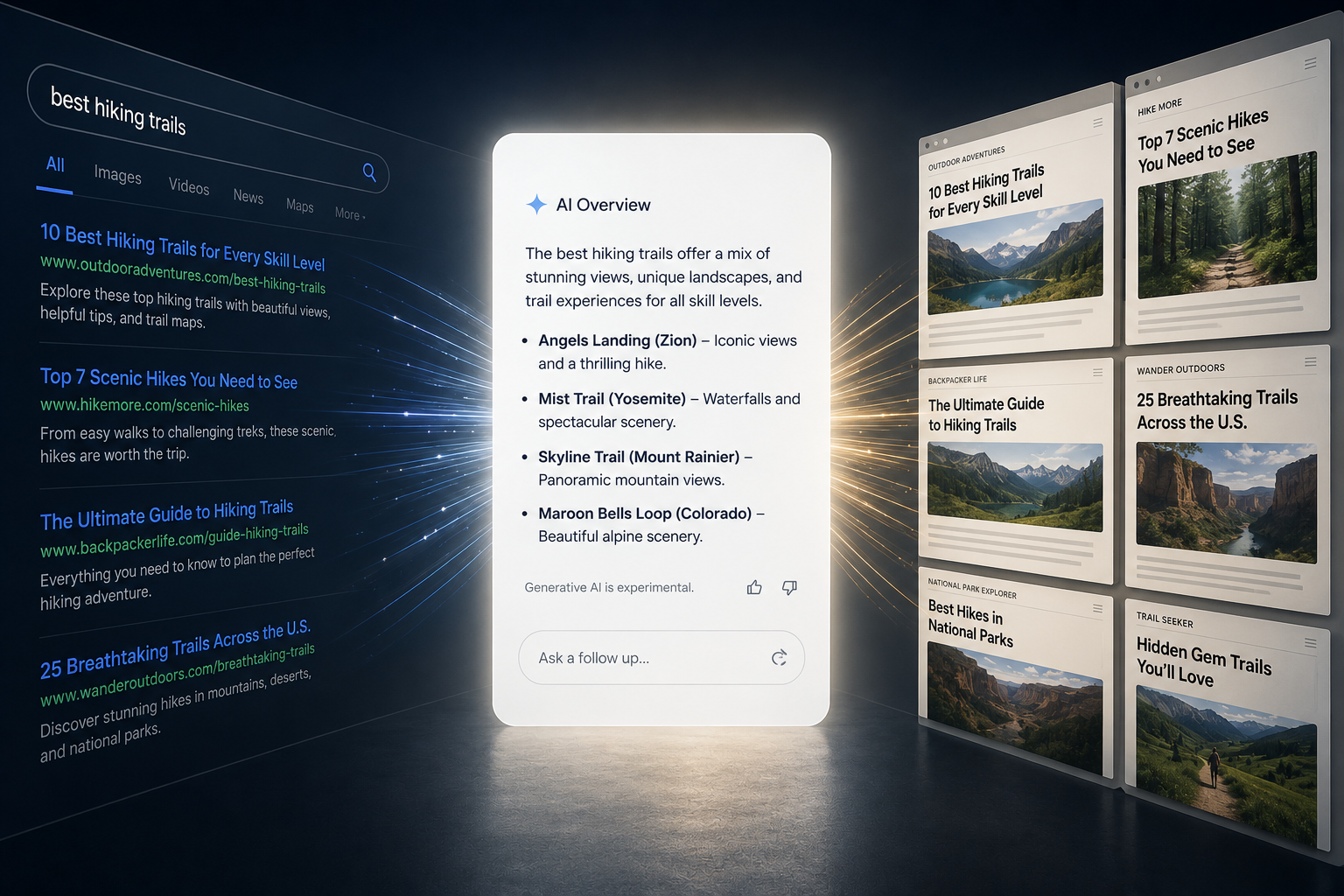
As traffic declines along with ad revenue, sites have been cutting back, been sold to private equity firms or shut down. Journalists have been being laid off and newsrooms decimated. And that's just one highly visible example. It’s having a rippling effect across all types of sites.
With that compact collapsing, it raises the question, who pays for the content on the web now. Blogs like this one were created as content engines. If the traffic is gone and the ad money is drying up, what happens to the content?
It’s a good question. Even if you believe AI is a better way to get answers, and that’s debatable, it still depends on the same steady supply of articles, data, information and documentation that used to come from websites. The problem is that no one has yet figured out a new model to create content at the scale that the old web model provided.
~Ron