FastForward #78: The AI revolution hasn't reached small business


Hi everyone. Welcome to our first September issue. Before we jump into this week’s newsletter, I’d like to thank Akamai for supporting FastForward as its very first sponsor. If you're interested in advertising here, please drop me a line at ads@fastforward.blog. If you like what you see, please share this week’s edition with a friend, and encourage them to subscribe. It really helps.💌 Sign up here.

ForwardThinking 🤔
The AI revolution hasn't reached small business
I had my first appointment with a new dentist this week and I noticed the shiny new modern equipment my previous dentist lacked. There was X-ray film that fit better in my mouth and a portable machine so the technician didn't have to move the heavy, awkward arm. There was a sonic cleaner that pumped air and water through as the hygienist cleaned my teeth.
There was even a TV on the ceiling running a loop of ocean life scenes (which was surprisingly soothing) and an electric train that cycled through, which was for the pediatric dentistry side of the house, but my inner six year old enjoyed it too. I also couldn't help but notice the clunky software the hygienist was struggling with as she entered information about my oral health.
At one point, she couldn't find the code for something, and when the dentist came in, he couldn't figure it out either. Finally, a third person, who clearly knew the software cold, came in and quickly found the problematic item.
And it's not just my dentist. Last year I was in a local Apple reseller shop buying an iPad and I was shocked (and frankly annoyed) by how long it took them to enter the information for the sale of one device. As my wife and I walked to our car, we talked about how truly awful this shop's customer experience was. It shouldn't have taken as long as it had.
The clunkiness of each of these systems (and other similar experiences) got me thinking of all the small businesses out there running on crap software like this and how AI was probably not going to come to rescue them from this mediocrity anytime soon.
Kicking and screaming into the future
When I wrote about small business and AI earlier this year, it was from the perspective that small businesses were having trouble implementing AI on their own in spite of the messaging that it's a presto-chango magical kind of activity.
Part of the problem isn't necessarily that small business owners aren't capable of figuring out how to take advantage of AI, it's more should they have to? They are spending money for software specific to their business whether a dental practice or a retailer, and they expect a certain level of proficiency from the developers, but as my experiences showed, they don't always get it.

That means, it's probably going to be up to the vendors to bring AI to the users if most users aren't going to come to AI. My dental hygienist and that poor guy at the Apple reseller want it to just work. She had trouble surfacing a code. AI could help by understanding the nature of her job as she enters data. The retailer could have a better agentic-driven workflow that improves both the user experience (much less hunting and pecking) and the customer experience (much less waiting).
As the charts below from an August US Census report on the use of AI in business illustrate, only around 20% of really small businesses with under 20 employees are using AI compared with more than 37% of their larger counterparts with 250 or more. It's worth noting this is looking at any type of AI usage, regardless of whether it's embedded in the software or not.
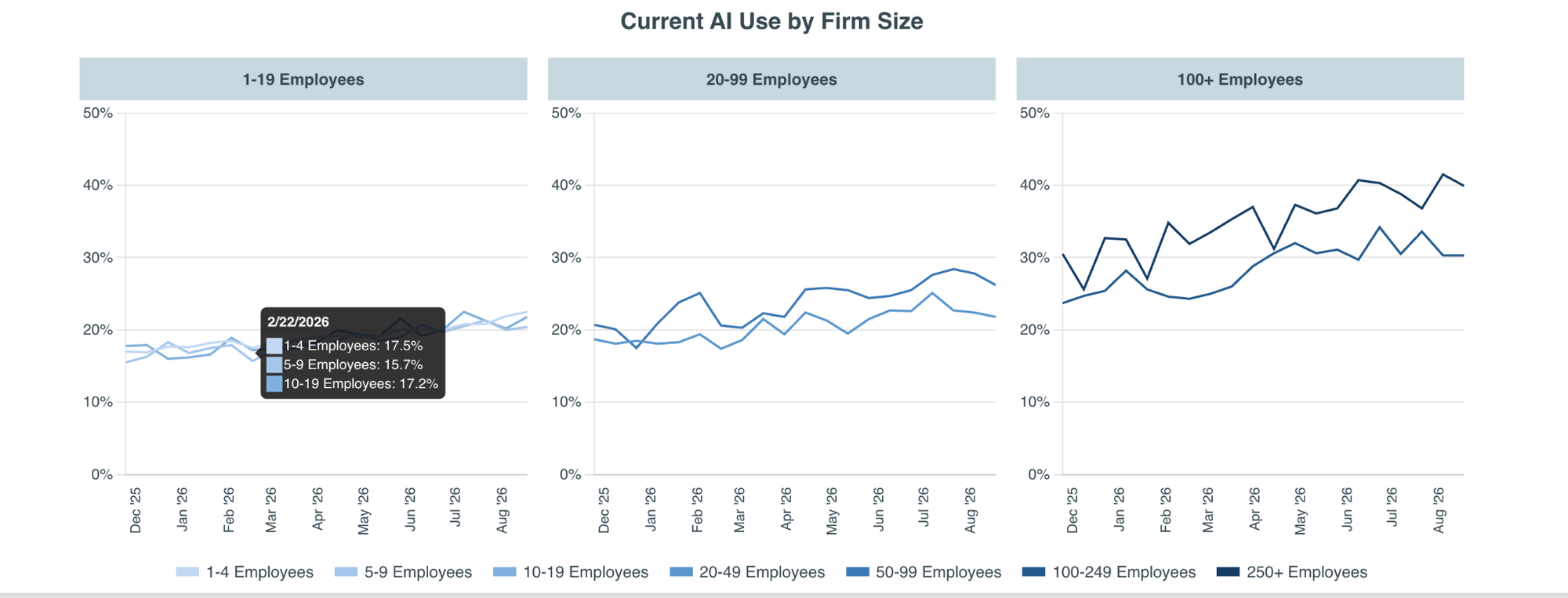
There could be lots of reasons for smaller small businesses eschewing AI, but it's probably because they aren't likely to use tools where it's not built in for them already. The best way to get AI to the smallest of the small (and probably most of us) is to make it so we don't even know it's there. In spite of AI coding speeding up development, that's still going to take a deep understanding of how the business works, and how to bring AI to the surface so the user doesn't have to think about it. I'm sure my dental hygienist would settle for software that could simply help her find the right code.
~Ron
What's new on the blog 📰
How Cisco helps acquired startups keep their creative spark
When I interviewed Cisco president and chief product officer Jeetu Patel recently on FastForward on PPN, I asked him about how he managed startup acquisitions to avoid losing the spirit of innovation that led the company to buy it in the first place.
Here's what he told me:
“If we had figured everything out, then we wouldn't be buying you.”
The entire podcast is embedded in the article.
How a 150-year-old insurance company is moving into the AI era
I interviewed MetLife CIO Nick Nadgauda to learn how a 150-year-old insurance company is transforming its tech stack for the AI age.
Using COBOL programs as an example, he says he looks at what to transform more from a maintainability perspective than a strict modernization one.
"I don’t necessarily have a problem with COBOL. The real problem in my mind is when you’ve got systems that you can’t support, where you can’t find programmers, you can’t find talent or they’re hard to modify."
Why Cisco’s Jeetu Patel thinks product strategy should drive acquisitions
I had the pleasure of hosting Cisco president and chief product officer Jeetu Patel on my FastForward on PPN podcast recently. I asked Jeetu about his build versus buy strategy, and he told me it was all about the products.
"The reason I don't like having a strategy which says what is your acquisition strategy, is that I don't have an acquisition strategy. I have a product strategy,” Patel told FastForward on PPN.
The entire podcast is embedded in the article.

IBM and OpenAI hope their partnership is the beginning of a beautiful friendship
IBM's partnership with OpenAI may be a no-brainer, but it should help both companies.
Note that I originally wrote about this partnership in a LinkedIn post, then expanded that in a News of the Week piece in FastForward # 75. This analysis takes a deeper look.
The repurposing of content across different platforms is intentional and part of my ongoing strategy to reuse content wherever possible.
Read the full story>>
In the debate over open-weight models, Capital One makes a different case
There is a battle raging in tech over the use of open weight models. On one side, the AI labs, the same ones telling us that their models got loose and hacked several websites, say the open weight models are unsafe.
Other companies argue that they need to be able to customize models, and the proprietary ones from those same AI labs make that much more difficult to do.
I spoke to Milind Naphade, SVP of AI foundations at Capital One, whose company doesn't care about the debate. They just need the flexibility that open weights provide to take advantage of their data.
"To do all that needs open-weight models, we just cannot do that without them. And why is that important? Because that's the only way that we can fulfill our twin mandates of delivering high accuracy with regulatory compliance," he said.
News of the Week 📣
Nvidia-Hugging Face deal could raise questions about AI power consolidation
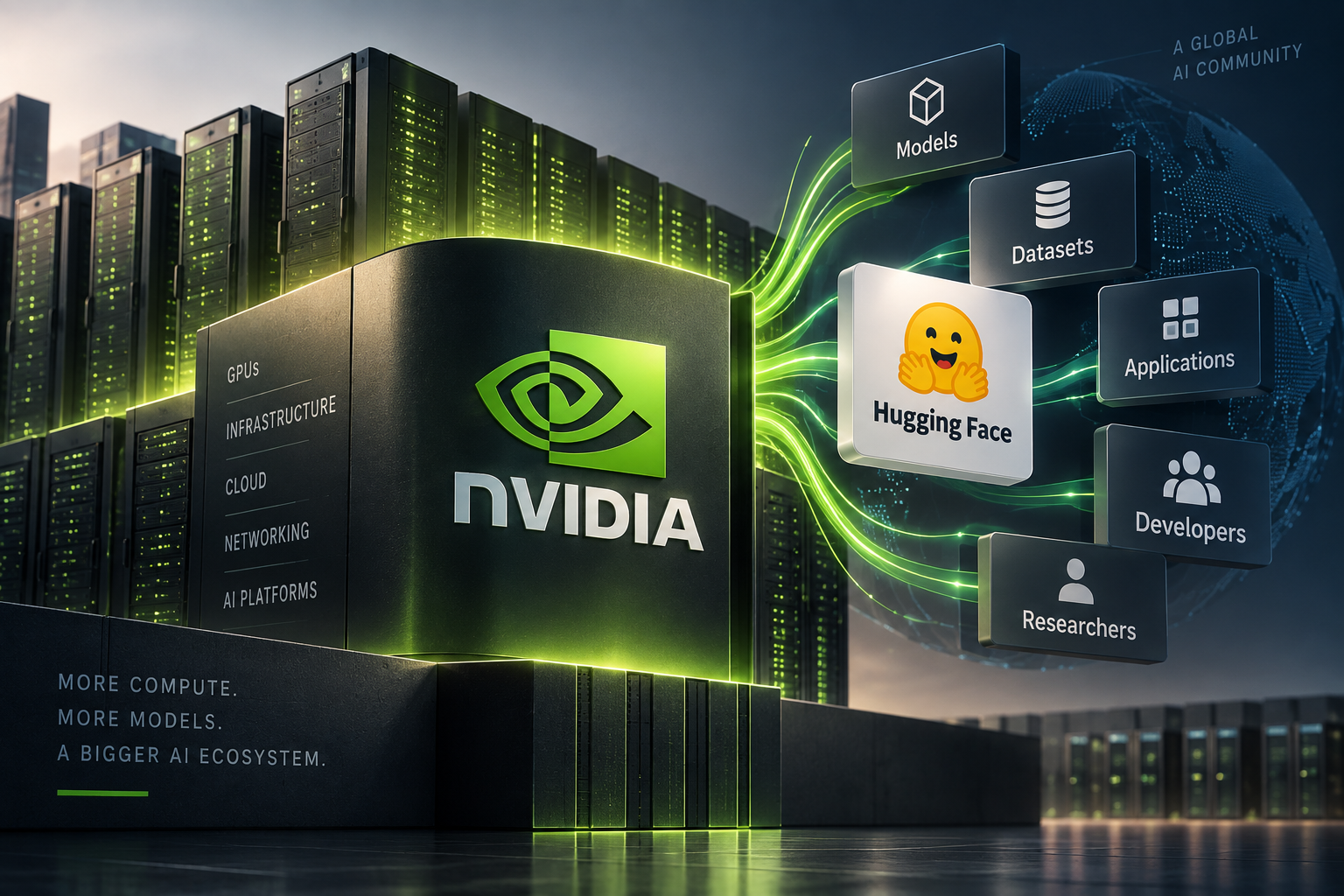
Nvidia is the most valuable company in the world. In its most recent quarter, it reported revenue of over $96 billion, up 106% YoY. With cash on hand over $22 billion and a market cap of $5.4 trillion, it has the financial flexibility to do just about whatever it wants. Rumors have been flying for a week that what Nvidia wanted was Hugging Face, the open source AI platform, sometimes referred to as the GitHub of AI.
On Thursday, the company made it official that it intends to acquire Hugging Face for approximately $13 billion. CEO Jensen Huang, writing in a blog post announcing the deal, went out of his way to assure the community how much he supported open source and open weight models, and that the platform would maintain its openness and technology neutrality (at least mostly or until it doesn't).
On Reddit people were clearly concerned about Nvidia owning Hugging Face with one person summing up the sentiment by saying: "Say goodbye to open source models now. We are screwed." But others see the strategic possibilities for Nvidia by giving them control of the "App Store" of AI.
The platform acts as a central AI hub for over 18 million developers, researchers and creators. It hosts 3 million models, 500,000 datasets and 1 million applications. "More than 200,000 companies use the platform to discover, evaluate, customize and deploy AI," per Nvidia.
As Nvidia consolidates more AI power between the extremely lucrative GPU business and now the access to a host of models and developers, it raises regulatory questions. Will the EU, UK or (less likely) the U.S. step in to stop this deal? Maribel Lopez, founder and principal analyst at Lopez Research isn't so sure, seeing a close analog to when Microsoft bought GitHub in 2018, which raised similar concerns in the open source community at the time.
"In general what is the revenue model you are upsetting? You’d have a GitHub alternative which isn’t exactly the same but could be argued [it's close], and it was purchased by Microsoft. To make an antitrust case is hard, especially since Nvidia will most likely keep it as is," Lopez told FastForward. But it's worth noting that when Microsoft bought GitHub, it didn't have the market clout that Nvidia enjoys today.
For now, the deal stands. If it passes regulatory muster, Nvidia will own a central hub for AI, enabling the company to extend its growing AI power base. It makes me wonder whether Nvidia controls too much of the marketplace, and if it's time for regulators to step in and check its growing power.
Hardware vendor revenue is surging under data center building boom

In the previous story we documented Nvidia's monster quarter, but it's not just the GPU giant that is benefiting from the AI data center building boom. Several hardware companies reporting earnings this week also reported swelling revenue, with evidence pointing to the AI data center building boom driving a lot of this growth.
Dell
Dell reported $47 billion revenue, up 58% YoY. What's more, it gave positive guidance to around $192 billion for FY 2027, while analysts were expecting around $173 billion, per CNBC, a healthy miss on the analyst's part. Investors loved every bit of it with stock up 9% overnight after earnings and up over 13% for the past five days. The company said the growth was driven by…wait for it…AI server sales, which it expects to triple for the full fiscal year.
Broadcom
The chip company also had itself a nice quarter reporting $30 billion in revenue up 86% YoY. It just beat analyst expectations. As with Dell, the growth was in large part due to AI with CNBC reporting, "Broadcom has been one of the major winners of the AI boom, designing custom chips for companies including Google, Meta and OpenAI."
HPE
Even HPE benefited with revenue of around $12 billion up 34%, on yes, demand for AI servers and networking. The company reported that it could have been even better, but they were dealing with component shortages. "HPE, one of the largest makers of computing equipment, has become a major beneficiary of the demand for hardware to train and deploy AI technology," Bloomberg reported.
When you combine this with Nvidia and Cisco's earnings, it's been a boom-boom quarter for hardware in general. The problem now is, by raising the bar, they will likely have to deal with analysts' growing expectations against this surging market backdrop. Some days you can't win for losing.
As OpenAI claims AGI, be skeptical my friends
It was hard not to notice when OpenAI president Greg Brockman told reporters this week that the company's latest model, GPT-6 Astra, was the beginning of the AGI era, a term that even Brockman admits is hard to pin down (yet he believes his company has achieved it with this release, whatever *it* is).
As he told The New Stack's Frederic Lardinois:
“I do leave it up to the reader to decide for themselves if this qualifies for them,” Brockman said. “For me personally, I do think we’re there. I do think there’s a pretty good argument for it. But again, I think this is the beginning of a journey, not the end.” He closed the briefing with this: “Welcome to the AGI era.”
Benchmarks always tell a limited story to me. It always comes down to usage. I haven't tried the latest version because it's unavailable to me yet, but using GPT 5.6 Sol, I've seen some incremental improvements in how well the bot understands my requests over earlier models, but I still see some of the same problems around getting it to understand my personal requirements in spite of making my guidelines available to it. It will be interesting to see if the model can lose some of its rigidity.
Humans have an intellectual flexibility that these models lack. As a recent example, I asked ChatGPT to find a quote for me in a transcript that met certain criteria, a pretty easy task. Here's the transcript. Find a quote. It kept trying to combine items that weren't actually said at the same time to accommodate my requests or straight up made up something.
This is a basic activity I as a human do all the time, but I find even the latest models have a hard time doing that or understanding that a quote is a quote and you can't mess with that (except for light editing for clarity, which comes down to my personal editorial judgement).
If AGI is human-like intelligence, I'm sorry, I can't see Astra suddenly closing the gap so quickly and thinking like we do. For now I remain skeptical of Brockman's claims, and I recommend you do as well. The proof of the pudding will truly be in the tasting.
What I'm reading 📚

Older Workers Are More Upbeat About AI Than 20-Somethings
~By Taylor Nicole Rogers, Bloomberg
Mark Zuckerberg Had a Secret Plan to Replace Meta Staff With AI Agents, and It Backfired Spectacularly
~By Victor Tangermann, Futurism
Pennsylvania’s A.I. Gold Rush Meets Second Thoughts
~By David Gelles, New York Times
What I'm watching 📺
Why OpenAI Will Never Return The $1 Trillion It's Investing | Mark Cuban
~Big Technology with Alex Kantrowitz
Look who's talking 👄
"The order momentum is super strong. In fact, as we said in our prepared remarks, our orders are growing 3.5 times faster than the revenue. What has limited us is the availability of supply."
~HPE president and CEO Antonio Neri in earnings call with analysts this week.