The AI revolution hasn't reached small business


I had my first appointment with a new dentist this week and I noticed the shiny new modern equipment my previous dentist lacked. There was X-ray film that fit better in my mouth and a portable machine so the technician didn't have to move the heavy, awkward arm. There was a sonic cleaner that pumped air and water through as the hygienist cleaned my teeth.
There was even a TV on the ceiling running a loop of ocean life scenes (which was surprisingly soothing) and an electric train that cycled through, which was for the pediatric dentistry side of the house, but my inner six year old enjoyed it too. I also couldn't help but notice the clunky software the hygienist was struggling with as she entered information about my oral health.
At one point, she couldn't find the code for something, and when the dentist came in, he couldn't figure it out either. Finally, a third person, who clearly knew the software cold, came in and quickly found the problematic item.
And it's not just my dentist. Last year I was in a local Apple reseller shop buying an iPad and I was shocked (and frankly annoyed) by how long it took them to enter the information for the sale of one device. As my wife and I walked to our car, we talked about how truly awful this shop's customer experience was. It shouldn't have taken as long as it had.
The clunkiness of each of these systems (and other similar experiences) got me thinking of all the small businesses out there running on crap software like this and how AI was probably not going to come to rescue them from this mediocrity anytime soon.
Kicking and screaming into the future
When I wrote about small business and AI earlier this year, it was from the perspective that small businesses were having trouble implementing AI on their own in spite of the messaging that it's a presto-chango magical kind of activity.
Part of the problem isn't necessarily that small business owners aren't capable of figuring out how to take advantage of AI, it's more should they have to? They are spending money for software specific to their business whether a dental practice or a retailer, and they expect a certain level of proficiency from the developers, but as my experiences showed, they don't always get it.
That means, it's probably going to be up to the vendors to bring AI to the users if most users aren't going to come to AI. My dental hygienist and that poor guy at the Apple reseller want it to just work. She had trouble surfacing a code. AI could help by understanding the nature of her job as she enters data. The retailer could have a better agentic-driven workflow that improves both the user experience (much less hunting and pecking) and the customer experience (much less waiting).
As the charts below from an August US Census report on the use of AI in business illustrate, only around 20% of really small businesses with under 20 employees are using AI compared with more than 37% of their larger counterparts with 250 or more. It's worth noting this is looking at any type of AI usage, regardless of whether it's embedded in the software or not.
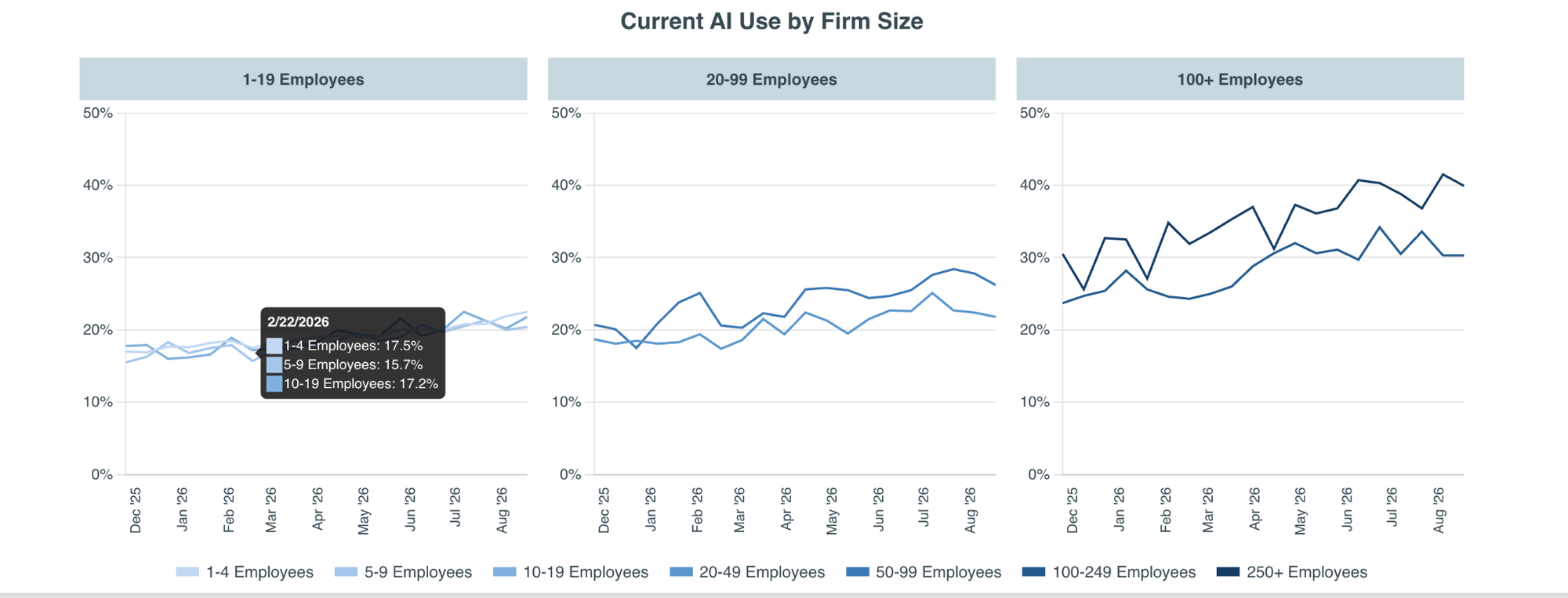
There could be lots of reasons for smaller small businesses eschewing AI, but it's probably because they aren't likely to use tools where it's not built in for them already. The best way to get AI to the smallest of the small (and probably most of us) is to make it so we don't even know it's there. In spite of AI coding speeding up development, that's still going to take a deep understanding of how the business works, and how to bring AI to the surface so the user doesn't have to think about it. I'm sure my dental hygienist would settle for software that could simply help her find the right code.
~Ron