
FastForward #52: Let's talk about SaaS, baby


ForwardThinking 🤔
Let's talk about SaaS, baby
Wall Street has spent the last two weeks in a full-blown panic over SaaS, with public SaaS stocks shedding hundreds of billions of dollars in value. Investors, behaving with their usual pack mentality, have suddenly decided that AI represents an existential threat to the entire SaaS model. It’s not entirely clear why this fear is peaking right now, but let’s be clear about one thing: SaaS isn’t going anywhere.
And it’s not just investors. Others, whether acting out of fear or opportunism, are piling on too. Exhibit A: ServiceNow CEO Bill McDermott tried to distance his company from the SaaS label last week, perhaps sensing it wasn’t a popular place to be.
McDermott was quoted saying, “We don’t live in the SaaS neighborhood.” Excuse me, sir, but you most certainly do. Those words came from the long-time SaaS executive after his company reported a pretty nice quarter, only to be met with a rude reception from Wall Street anyway. It was another sign that people were jumping on the "SaaS is doomed" bandwagon.
SaaS stands for Software as a Service, a way of delivering software via the cloud instead of on-prem in a private data center. Just about every company that sells software these days, with a few exceptions, is based on this model. For the CEO at one of the premier enterprise SaaS companies to suggest his company is something else borders on absurd.
Why do some people think it's doomed and why is McDermott trying to distance his company from the term? AI coding, of course. The argument goes, if you can code anything, you can build your own enterprise software, and that spells doom for the companies currently building it. But the thing is, while AI coding tools are a huge advance, they aren't likely to take out a whole category of technology overnight, especially in large enterprise organizations.
The complexity problem yet again
I don't want to minimize the power of AI coding because it appears to provide a real efficiency lift, but I do think it's a bit much to suggest that every company is now going to build their own bespoke enterprise software without putting their core businesses at risk.
Part of the problem is understanding just how complex enterprise software really is: how many systems it must connect to, how much technical debt has piled up over time, and the fact that IT fundamentals still apply.

As my former colleague and boldstart founder Ed Sim wrote last year, agents still have to solve the last-mile problems, the hard ones you can't simply gloss over like “security, privacy, compliance, integrations, determinism and repeatability, accuracy, memory, cost, orchestrating swarms of agents, and even more security.” If enterprise software companies like ServiceNow are struggling to solve all of those problems, it's a stretch to think anyone can just build it themselves and put companies like ServiceNow and Salesforce out of business.
SaaS's reckoning
But just because enterprise SaaS companies aren’t likely to be replaced anytime soon doesn’t mean they shouldn’t take a hard look at why customers are increasingly open to considering building their own alternatives.
As Constellation Research founder and principal analyst Ray Wang wrote in a Monday Musings column back in 2024, companies were already getting fed up with fat SaaS bills. "Recent conversations with more than 100 CXOs in the Constellation Executive Network indicate that their satisfaction with technology vendors has reached an all-time low," Wang wrote. He cited an example of a CRM vendor that was trying to push a $20 million increase when the company was trying to cut their costs by that very same amount.
Sales teams are gonna sell, sell, sell, but they can't be tone-deaf, or customers will search harder for ways to shake them off. That's even more true today as companies push agentic AI and the pricing squeeze Wang described only gets worse. At some point, someone’s gotta pay those big infrastructure bills to power the AI.
No, SaaS isn’t dying, no matter what Wall Street investors may think, but what could be happening instead is a long-overdue reset on pricing, value and expectations. Enterprises may be frustrated with their software vendors, but that frustration doesn’t mean they can magically turn their businesses into enterprise software companies overnight. And no amount of AI coding changes that.
~Ron
What's new on the blog 📰
MCP Apps starts moving real work into the AI chat interface
MCP Apps, released last week, brings application workflows directly into the AI chat interface. It’s an important step for implementing agentic behavior, but it is still constrained to one application at a time.

Exclusive: Kilo Code bets on agentic engineering with a model-agnostic CLI spanning 500 AI models
This is our first FastForward exclusive: Kilo Code, an early stage startup co-founded by GitLab chair Sid Sijbrandij, is rolling out a new model-agnostic CLI that works across more than 500 AI models. The startup is betting that the next phase of AI development is about managing agents and workflows, not just chatting with models.
The Super Bowl remains a defining moment for brands to show their stuff.
It’s Super Bowl week, and as the New England Patriots face off against the Seattle Seahawks in Santa Clara this weekend, it’s pretty much my obligation to write about it.
I spoke with Adobe Enterprise CMO Rachel Thornton about how the game has become a showcase for brands, so much so that for some folks, the ads matter as much as the game itself.

How ServiceNow is preparing for an agent-driven enterprise future
I recently interviewed Amit Zavery from ServiceNow, a man who has been at the forefront of enterprise software for decades, about the company's strategy to embrace agentic AI, whether organically or via acquisitions.
Here's what he had to say about the company's flurry of acquisitions last year: "Our 2025 acquisitions don't represent a pivot away from organic growth and building, they represent an acceleration," Zavery said. "We're focused on acquiring strategic capabilities."
News of the Week 📣
Capex gone wild

Remember the quaint old days of 2025 when we were dazzled because Amazon, Microsoft, Alphabet, Meta and OpenAI committed $420 billion to building new data centers. It was supposed to satisfy the surging demand from AI, a beast whose hunger for compute seems unending.
Well, last year's numbers pale in comparison to what we've heard from the hyperscalers in this year's most recent earnings cycle. These companies are going wilder than a group of college students on Spring Break in Florida.
Amazon is leading the binge with a whopping $200 billion commitment. The chart below tells the rest of the story, a total that could reach over $700 billion for one year. It's worth noting that the OpenAI amount is tough to nail down as it's a private company, and it's constantly announcing deals with one company or another, but this a guesstimate based on its Stargate announcement last year. It could be bigger (or smaller).
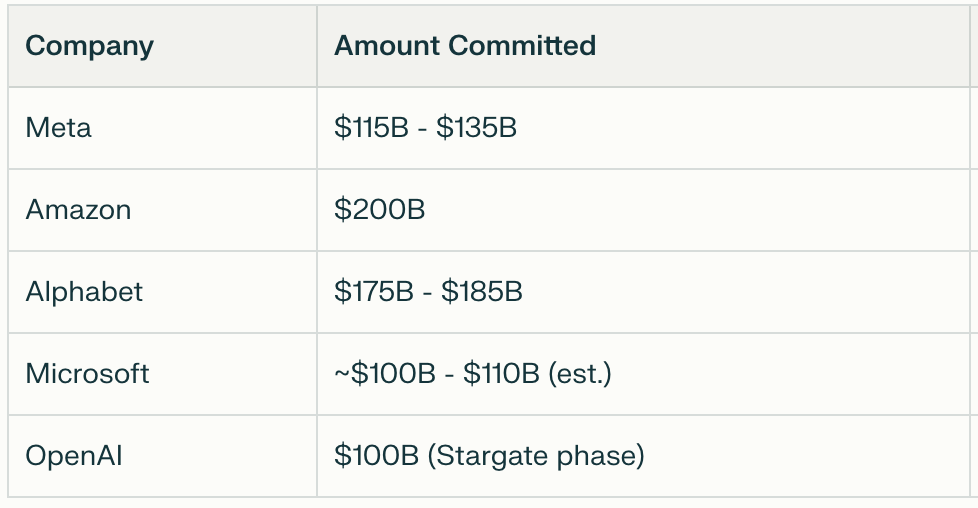
These numbers also come in the wake of massive layoffs at Microsoft and Amazon. It seems these companies have plenty of money to spend on machine resources, less on the human variety, and that's not a great look. But whether these companies can actually find the land, water, electricity and skilled labor to build these data centers remains an open question, no matter how much money they are willing to throw at it.
Cloud infrastructure revenue reached $419 billion in 2025
There's a reason for all that projected spending reported in the previous article. The cloud infrastructure vendors continue to report more demand than supply. Their answer of course is to keep building, and that is the plan for this year.
As for the quarterly and yearly numbers, stop me if you've heard this before: It was another monster quarter for the cloud infrastructure market. Synergy Research reported $119 billion in quarterly revenue across the sector, and a total of $419 billion for 2025.
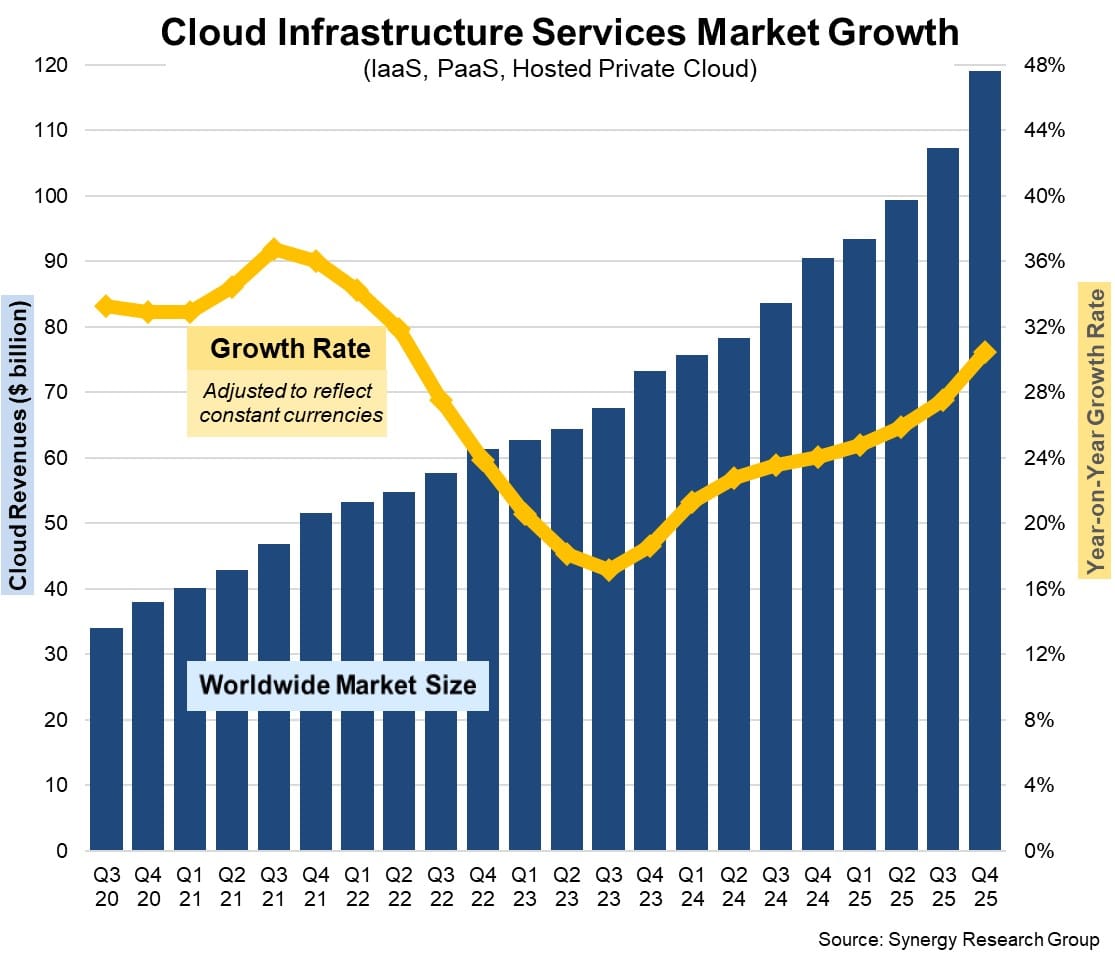
If you're looking for answers as to why a mature market continues to boom, you don't have to look too far. "You don’t have to be Sherlock Holmes to figure out that AI has driven these changes," Synergy's chief analyst John Dinsdale wrote in an email announcing the new numbers.
Amazon's once massive lead has continued to shrink over time as the gap between Amazon and Microsoft has begun to close. But Google also continues to grow too. The market share percentages broke down to 28% for Amazon, 21% for Microsoft and 14% for Google. That's compared with 29%, 20% and 13% respectively last quarter.
I'll be exploring the numbers more in-depth in a longer piece next week. Watch for it.
Intel is building a GPU; is it too late?

Nvidia is the undisputed leader in GPUs, but long before that company existed, Intel helped define the silicon in Silicon Valley. It has lost some luster in recent years, but under the leadership of CEO Lip-Bu Tan, who took over in March last year, it is attempting to find ways to be relevant again.
At the recent Cisco AI Summit, Tan announced that the company had hired a new chief architect, who has begun research to build an Intel GPU. Reports peg that person as former Qualcomm executive Eric Demers.
It's worth noting that even as the company tries to return to some of its former glory, one of its investors is Nvidia itself, creating an interesting dynamic to say the least. In the short term, Nvidia won't be exactly quaking in its boots, but if Intel were to build something compelling, it could get awkward, and that is worth watching.
My adventures in AI 🤖

This is an extremely cool and practical AI use case. Spotify has released a beta called Prompted Playlists.
As you would think, you enter a prompt and Spotify creates a playlist for you based on your instructions.
The possibilities are endless, but instead of relying on algorithms to learn about your listening style, you can create whatever list your heart desires. As a music lover, it puts the entire catalog at your beck and call in a way that would never have been possible before.
As I played with it over the last several days, I can see that it's not flawless. When I tried to edit an existing prompt, it broke because I asked for 50 songs instead of the original 25. It seems to have issues with more than 25 or 30 tracks.
It sometimes claims it can't see my playlists, while other times I was able to create a best of list based on my entire library of playlists going back more than a decade. I would like to be able to interact with the prompt to be able to correct it, not just have it be one way.
It's important to remember it's still in beta, so Spotify is obviously working out the kinks, but it is a great start, even if it still needs work.
This post originally appeared on my LinkedIn.
What I'm reading 📚
The Minneapolis tech community holds strong during ‘tense and difficult time’
~Dominic-Madori Davis, TechCrunch
Apple’s Historic Quarter Doesn’t Change the Need for AI Reckoning
~Mark Gurman, Bloomberg
No, the Singularity Hasn’t Arrived: The Truth About Moltbook
~Mike Elgan, Machine|Society
Wall Street's AI honeymoon phase is over
~Madison Mills, Axios
Look who's talking 👄
"This isn't some sort of quixotic top line grab. You know, we have confidence that these investments will yield strong returns on invested capital."
~Amazon CFO Brian T. Olsavsky defending Amazon's massive capex spending at yesterday's earnings call with analysts.